I had been to Stanford Stadium twice before, but both times were in the 20th century. Went to a Big Game (Cal-Stanford) and to an exhibition game there between the then-Oakland Raiders and New England Patriots. Son Dillon, big Pats fan, joined me for the latter game.
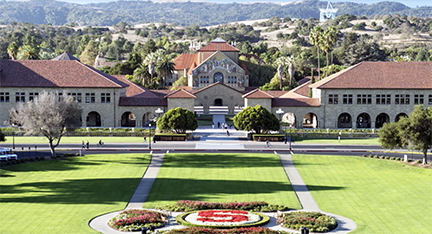
I had not experienced the Stanford campus, however. Had seen lots of pictures of the buildings and knew the campus was huge, but I wanted to spend time there walking around and also to scope out the locations near the stadium where we wanted to have our tailgate.
I went to the campus, about a 45-minute drive from Moss Beach, Friday morning and parked at the Visitor Center, where I picked up a map. My first walk was to the stadium and, more importantly, the Arboretum adjacent to it. I had purchased a parking pass in that location.
Instead of paved parking lots, the stadium is surrounded by groves of trees. Tailgaters park among the trees, which provide shade. It’s just a much more pleasant environment for a tailgate than an open field or parking lot.
After getting some eyes-on orientation to the tailgating location, I headed to the academic area of the campus. I took just under 11,000 steps that day, which an online calculator gauged to be just under five miles.
Stanford did not begin its “autumn quarter” until more than a week after the BC game, so the students on campus were primarily grad students. And while the campus is open to automobile traffic quite extensively, based on the number of bicycles I saw being ridden or in racks, it’s a bike-centric campus.
Official University logo
The Stanford logo is a cardinal red “S” with a green sequoia tree superimposed on it. After walking around that campus, I get it. Trees are plentiful and are somewhat honored with arboretums and identified “groves.” (The “Stanford tree” that you see with the Stanford student band is the mascot of that band, long recognized for boisterous and, in the opinions of quite a few, offensive behavior. The University has no official mascot.)
Below is a gallery of scenes from my walkabout. Clicking on any of the thumbnails will present larger image.
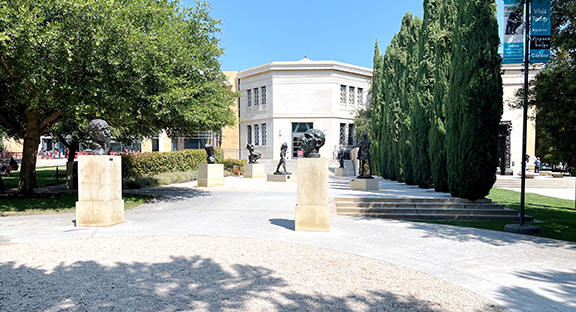
A specific target of the walkabout was the Rodin Sculpture Garden, with 20 of the noted sculptor’s most famous sculptures on display among cypress trees and gravel paths on an acre of land.
Entrance to the Rodin Sculpture Garden
Here’s a slideshow of some of the sculptures in the garden.
I wore a somewhat bold BOSTON COLLEGE shirt on my tour and ran into several fellow alumni doing the same walkabout as I was. At one point, I came upon an older gentleman who asked me to take a picture of him and his daughter, which I did happily. He told me she was on campus to begin her doctoral program at Stanford. She was aware that BC and Stanford were to play the next day and wished us luck.
I had decided that I would drive up to Stanford for the long weekend. It would enable me to bring some of the “infrastructure” for the tailgate, e.g., a folding table, couple of camp chairs, and a large cooler for food and drink.
I had made the drive to SoCal from the Bay Area and back several times when we lived in the East Bay a few decades ago. Most recently prior to this drive north, I had done it in 2017, picking up my daughter, son-in-law, and two little granddaughters at SFO and spending a few days showing them where their mother had lived, gone to school, etc.
I left at 7 am Thursday, two days before the game, figuring most of that day would be on the road. The drive was going to be just under 500 miles and GPS said it was going to take about eight hours. I also planned to stop twice at Costco, one just north of LA and the other in Gilroy, for restroom and fuel stops.
GPS also advised me to take the 5 (Interstate 5 to non-Californians) through LA. I knew most of the trip was going to be on the 5, the main north-south highway through California’s Central Valley. Was a little surprised GPS advised getting on it south of LA.
It wasn’t until I was stuck in morning bumper-to-bumper commute traffic that GPS finally advised an alternate route. It took me off the freeway into some of the least attractive areas of LA and then up onto the 210 to the east of LA through Pasadena.
There I was able to see some of the burn scars resulting from the fires back in January, as shown here.
Burn scars at upper left near Altadena.
The first stop at Costco was 90 miles from my house. It took me three hours to get there.
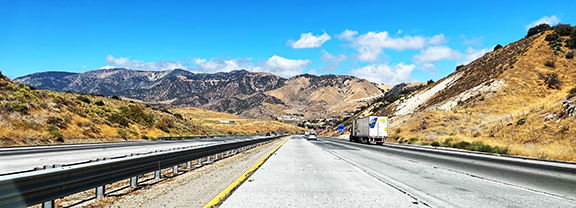
Going through “the Grapevine” north of LA on the 5 always seems interesting. Grapevine is not a formal name. There are various local references to grapes and grapevines, but it is where the 5 stretches from Santa Clarita, just north of LA, to California’s Central Valley.
The freeway goes through the Tehachapi Mountains, reaching an elevation of 4,144 feet at the Tejon Pass.
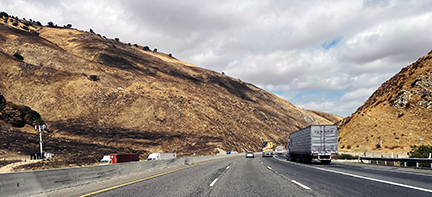
The Grapevine. Again, burn scars ahead on the left.
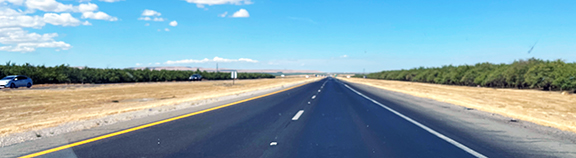
Once through the Grapevine, the Central Valley stretches ahead to the horizon and the 5 is flat and straight.
The straight 5.
For more than 100 miles, the only change in direction of any note is changing lanes on occasion.
On my second stop at Costco, in Gilroy, I picked up some of the local produce from the “Garlic Capital of the World.” Just garlic bulbs, not the garlic ice cream.
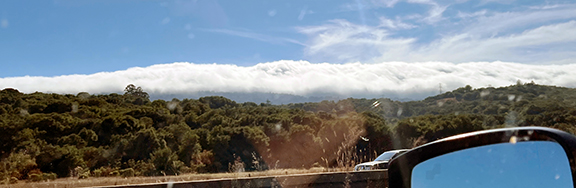
The weather forecast for Moss Beach and Half Moon Bay had changed significantly just days before. Instead of clear skies and high temperatures in the low 70s, the forecast was for the marine layer to persist throughout and for high temperatures in the low 60s.
From the road just east of the bay, evidence of the marine layer’s “cat’s paws” was pretty strong.
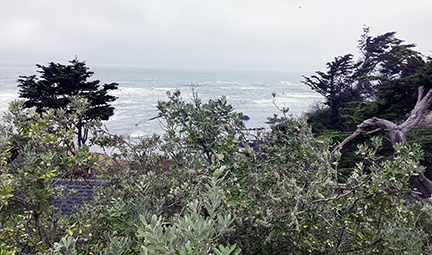
The last of the group to arrive at our Airbnb around 5 pm, I enjoyed the view and the chance to rest.
When it was announced that Boston College would play new ACC member Stanford in football September 13 this year, San Diego Eagles were interested in the opportunity to see their football team play on the West Coast for the first time in 12 years.
To assist, I contacted the Stanford ticket office in the spring to inquire about group discount tickets through them. We decided to set aside 50 seats on the upper level of the visitor side of the stadium at midfield ($40) and another 50 in the adjacent section ($25). They went on sale May 1.
We shared information on the tickets with members of the San Diego chapter, as well as alumni chapter leaders in Orange County, LA, and San Francisco.
Long story short, later in mid-summer we expanded the number of tickets assigned to us at midfield and ultimately sold 120 there.
I had purchased 10 tickets and transferred them via the web to nine classmates and partners who planned to head west for the game, replacing the usual game at BC for which I would travel east to join them. That was a nice change for me.
Jujube’s final visitor experience in May was at the Birch Aquarium, part of the Scripps Institution of Oceanography at UC San Diego.
We were joined on this trip by her nieces, Addy and Alice.
One of the main attractions at the aquarium is the recently-completed Scripps Living Seas Gallery, which displays several of the ecosystems and sea life of the Pacific.
Here is a sampling from that exhibit. First, fish . . . and some Garden Eels, which look like worms in sand. (The videos in this post can also be viewed on YouTube. Just click on “YouTube” at lower right.)
Also, jellyfish.
A small ray provided viewers a lot of enjoyment doing something that seemed to give it some enjoyment as well. It spent several minutes repeatedly seeming to climb up the tank and then glide down. On the video below, you can also hear a young child urge it on.
The aquarium also offers an extensive selection of seahorses and seadragons. Here are some.
Jujube and the nieces spent a lot of time at “Blue Beach,” an activities space at the Aquarium. There, they used available materials to build small boats and test their seaworthiness in a flowing stream.
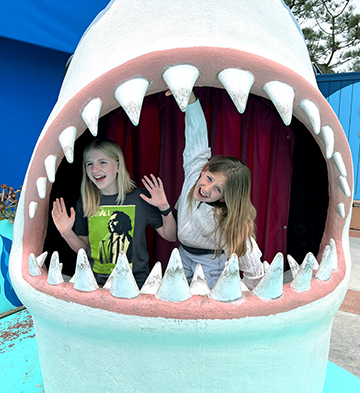
The nieces also fulfilled an Aquarium-visit requirement at Blue Beach by posing in the shark’s mouth.
Another distinctive exhibit at the Aquarium features Little Blue Penguins, native to New Zealand and southern Australia. They’re the smallest penguins, generally growing up to 10 inches tall and three pounds in weight. They don’t live in snow, but on coastal dunes and rocky shores.
I enjoy watching octopuses, but rarely see them in action. Often, they seem to be avoiding public view, up in a corner of their space. Not on this visit! Got to see one in action, moving across the tank.
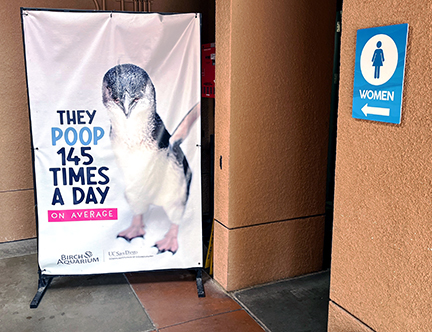
Finally, on the way out with a stop at the restrooms, noticed this sign. I assume “they” are penguins, not women.
On Tuesday during Jujube’s visit in late May, she and I made a brief visit to the San Diego Zoo Safari Park in Escondido. They had added a Walkabout Australia section since she had last visited.
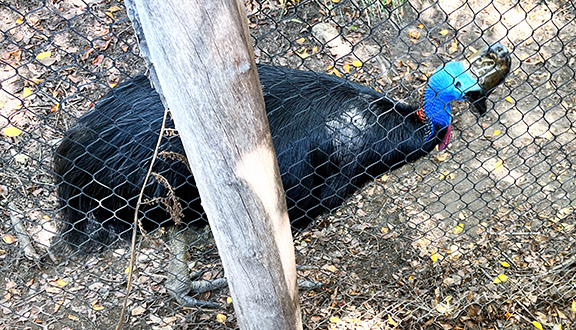
There we were able to see a cassowary (above), a large flightless bird most closely related to the emu. They’re native to Northern Australia, New Guinea, and nearby islands. Emus are taller than the cassowary, which is 4-5 feet tall, but the cassowary is the heaviest bird in Australia and second heaviest, to the ostrich, in the world.
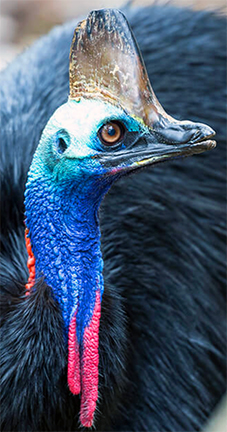
Among the unusual features of the cassowary is its casque (helmet) atop its head. While distinctive, its purpose is uncertain. According to the Zoo’s website, the casque is “made of a sponge-like material and covered with a thick layer of keratin, the same thing our fingernails are made of. Although it is quite sturdy, the casque can be squeezed in the middle fairly easily.”
Two of the three cassowary species have “wattles,” fleshy pouches of skin hanging from the neck. They are colored blue, red, gold, purple, or white, depending on the species or subspecies. Again, the purpose is uncertain.
The cassowary is most active at dawn and dusk, so we were fortunate to view ours in motion and relatively nearby. To get a better view, the photo at left is from the Zoo website.
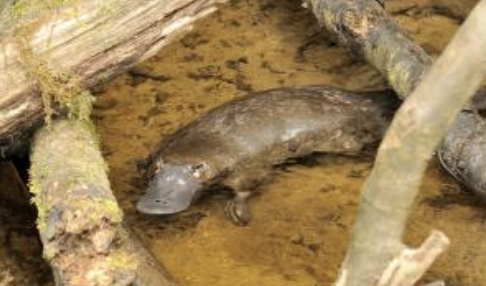
Also visited the platypus exhibit. The Safari Park is the only zoo outside Australia to have platypuses. They are nocturnal, so their exhibit is darkened during zoo hours, and it is difficult to see them clearly.
The platypus is an egg-laying mammal, one of only five such species. Again, we’re going to use a photo from the Zoo website.
During her visit in May, Jujube (my daughter’s nickname) suggested a visit to a gold mine in Julian, a historic community in the mountains of East San Diego County, at about 4,200 feet elevation. Julian is an official California Historical Landmark due to its role in the 19th century California gold rush.
Our guide at the mine said Julian in 1869 was site of the last of the “gold rushes” in California, with the first being THE California gold rush of 1848, when gold was discovered at Sutter’s Mill in Coloma, 35 miles northeast of Sacramento. That discovery brought about the largest mass migration in U.S. history.
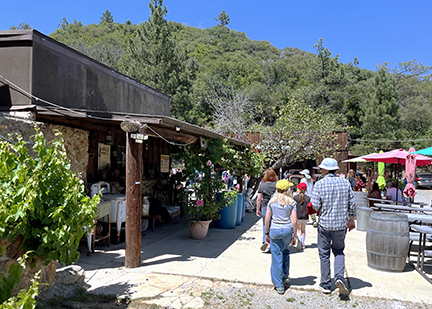
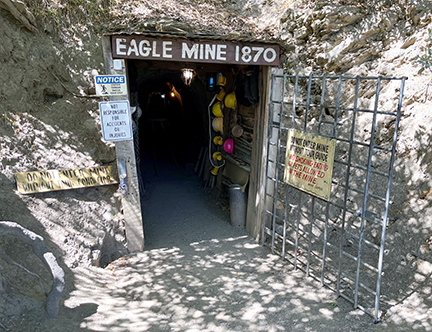
Parking in “downtown” Julian, we walked up to the Eagle Mining Co., which offers tours of its mine and gives an orientation to panning gold.
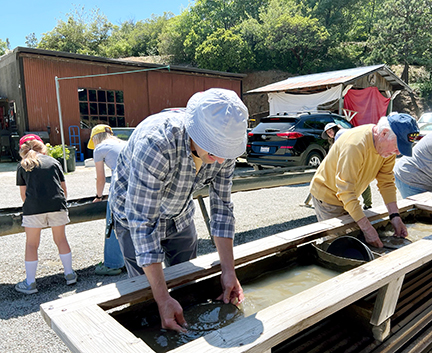
Winter and I, with Addy and Alice at rear, pan for gold.Tiny, shiny bits of gold in Julia’s pan.
Guests can pan for real gold, but you don’t get to keep what you find. Best anyone can do is find a few flakes, which Winter and I found. Jujube’s pan, however, was a little better.
Then we entered the mine, which had been created in 1870, for a tour of about an hour’s duration. You don’t do down into the mine, you enter directly into the side of the mountain at what the guide was the seventh level of the mine, with six levels below and at least one above.
The guide warned tour participants that some might feel claustrophobic because of the narrow and low tunnels. (Post tour, we all agreed we didn’t feel claustrophobic, but did occasionally wonder what would happen if there was an earthquake while we were there.)
This video gives a “hint” of what it was like in the mine.
At one point, the guide lit a candle that had been put along the tunnel wall, and then turned off the electric lights, to show us something like the condition for mine workers in the 1800s. Then he extinguished the candle and we were in darkness as total as I had ever been in.
At the end of the tour, we went up one level to exit from higher up on the mountain side.
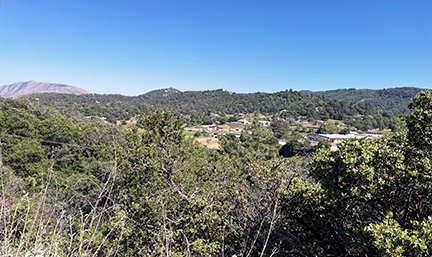
View from the exit level.
The guide, as I recall, said the value of the gold extracted during the active life of the mine was several million dollars in today’s currency.
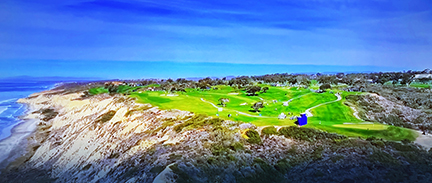
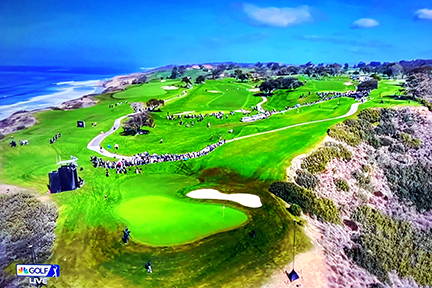
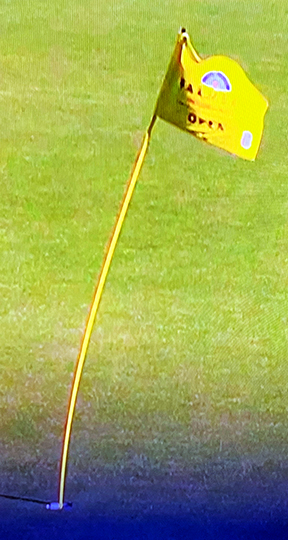
The 2-3-4-5-6 South neighborhood at Torrey Pines. 3 South on the lower right.Winner Harris English and his daughter being interviewed after the win.
(This is so tardy. I apologize.) I use “English” both to mean a spin on a situation and to refer to the winner of the 2025 Farmers Insurance Open. Harris English won the tournament by one stroke, finishing eight under par.
But the other “English” was that golf was not the most dominant topic among my volunteers on 3 South, the par three above the Pacific. Most of our attention was on fires.
The tournament took place January 21-25, Tuesday-Saturday. The fires in LA had started two weeks earlier and were in the forefront of people’s minds. But so was the local weather. High winds were forecast throughout the tournament and no rain.
Drone overhead of 3 South
Tuesday was the pro-am event. First tee-off was at dawn and we were all supposed to be in place by then. I’m about an hour north of the course, so I was on the road significantly pre-dawn. I headed east toward the 15, the inland north-south freeway, instead of the 5, the freeway along the coast.
As I approached the 15, I saw red brake lights all along the south lanes. Nobody moving. Had no idea why that was the case, but I turned around and headed for the 5. Couldn’t be worse. Maybe 20 minutes later, I heard on the car radio that traffic was stopped on the 15 in Bonsall, just south of Fallbrook, because of a fire.
It was in the same general area as the fire that, in 2017, required me to evacuate. (You can see my post on that event here. And I soon thereafter learned it had the same name, the “Lilac Fire,” which is based on location, near Lilac Road.)
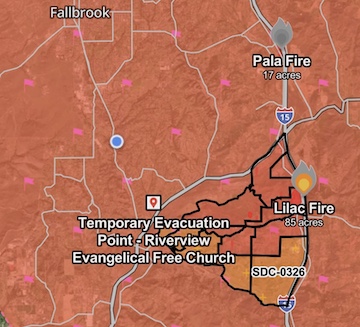
When I got to the course, I was able to access “Watch Duty,” an app that gives status of reported fires. It showed that evacuations had been ordered near the fire and warning zones were close by, i.e., about two miles from our home. Here’s a Watch Duty map showing location and evacuation zones.
Our house is the blue dot, left middle.
I figured that if we ended up in a evacuation warning zone, I was returning home. (The evac zones never expanded.) So, from the start, attention was on the fire more than the golf.
It wasn’t long after play began on Wednesday that we learned there was another fire alongside the 15, the Center Fire, in Rancho Bernardo. That was near the home of one of my marshals and she had to leave.
By Thursday, the Border 2 Fire was also underway in South County, joined on Friday by the Friars Fire in Mission Valley and the Gilman Fire in La Jolla, right next door. More volunteers needed to head home.
Rather than looking at ball flights, we spent a lot of time scanning the horizon for smoke . . . and too often seeing it.
Gusty winds were prevalent most days.
On Thursday, play was halted in the early afternoon because 35+ mph wind gusts were making balls on the greens oscillate. I think a lot of people did not expect play to resume that day. And with the additional fires in the area, the choice between standing around on the course with nothing happening or heading home to check things out seemed clear.
Someone on the radio network used by hole captains reported, “Many volunteers are leaving the course.”
Play was resumed, however, but had to be called again before completion of the round because of darkness. With travel time included, it meant a 13-hour work day for me.
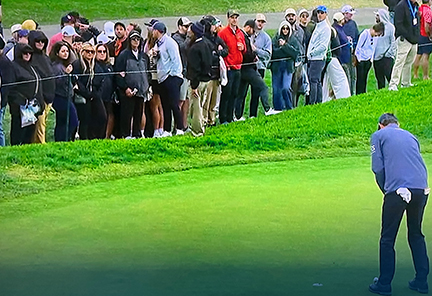
Friday was the only relatively calm day of the tournament, at least weather-wise. The final round Saturday was the only time the tournament was on network TV and it must have been a bummer for the San Diego Chamber of Commerce. National viewers saw fans in sunny San Diego wearing parkas as temperatures only got to the upper 50s. Hardly encouraging tourism-wise.
Chilled fans in parkas and other “winter” wear Saturday.
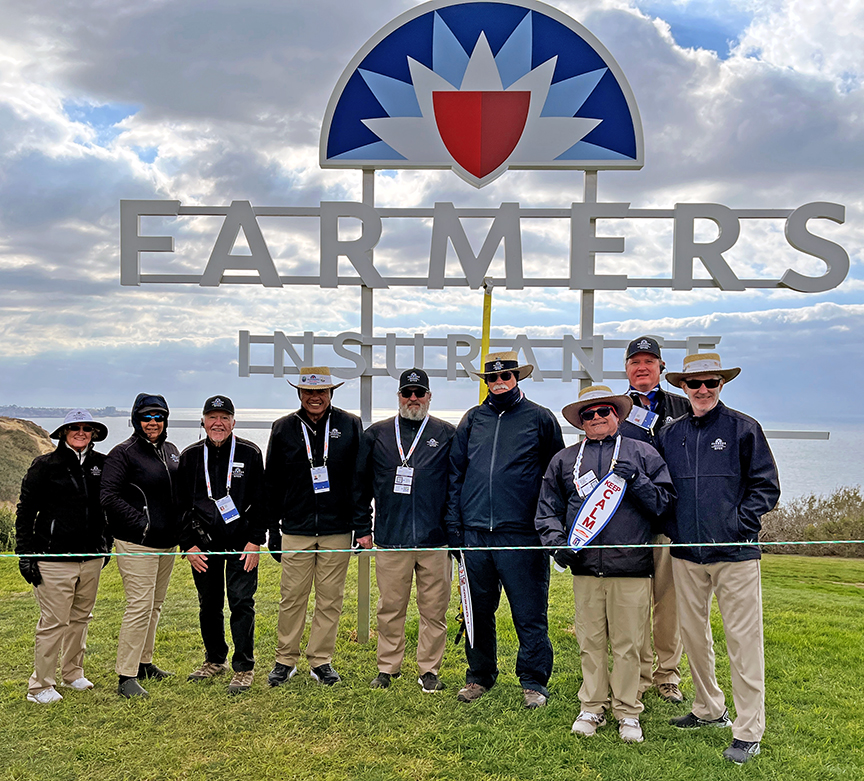
Thanks again to the gallery management and competition support volunteers manning 3 South!
Sticking with the “Christmasy” red and green of the Sticks on Fire plant in the yard for the family photo.
The insert photo also gives a hint of one element of family news. Julia and Sam moved to Arlington, Va., this year, along with the dog, Tarski. Sam was reassigned to the DC office of Leidos. Dillon was just visiting them. He still lives in Ypsilanti, Mich., working in Ann Arbor for the National Center for Manufacturing Excellence.
Also of note is the attire of the two groups. Dillon and Julia, at least, in winter gear, while the SoCal contingent basks in warm sun in early December.
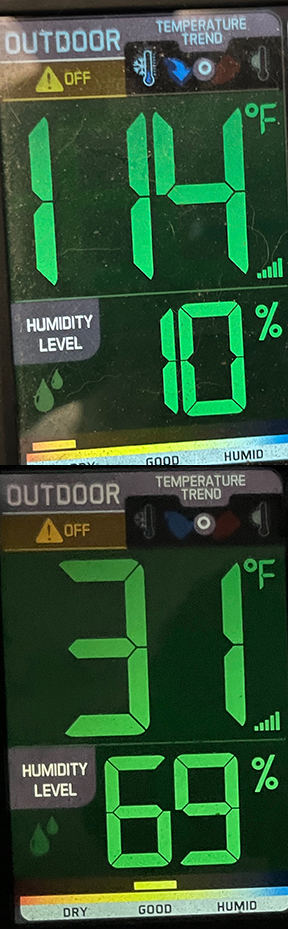
We also have extremes, of course. A new record high temperature at the house came in early September. In fact, it’s the highest temperature I’ve knowingly experienced. Previous record was 111, in the desert, but in early evening. The freezing mark is less common than triple digits, but has happened a few times in recent mornings, when I get to walk Baxter outside.
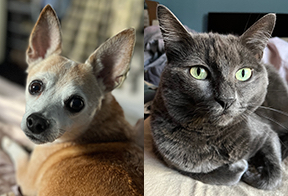
Appropriate time, I guess, to show recent photos of Baxter and Cinderella.
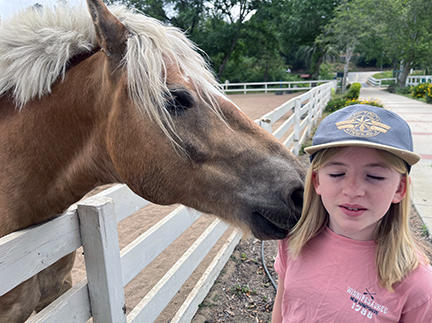
We’re getting to know other animals, as well. I had mentioned last year starting as a volunteer at a local therapeutic horse-riding program. Adeline turned 12 early this year, becoming eligible to be a volunteer at REINS. And this summer, she joined me on our Tuesday morning shifts. Addy’s favorite horse is Bam-Bam, maybe because they have similar hairstyles.
Still start the year as a volunteer at the Farmers Insurance Open at Torrey Pines and I will be hole captain at 3 South again next month. It’s a Wednesday-Saturday tournament now because of changes in the NFL playoff schedule and its long-term future is uncertain. Hey, so’s mine.
Annual trip to Boston/Cape included a new element, visiting Julia and Sam beforehand. Staying with friends in adjacent Alexandria, my room was on the fourth floor of their townhouse. Julia’s apartment is a fourth-floor walkup. I set personal records for flights climbed. Their place is very close to the Marine Corps War Memorial.
Otherwise, the trip centered on the BC-Michigan State football game, which I didn’t attend. Last year, I reported on how unpleasant it had been to go to the BC-Army game at West Point in the pouring rain. Same weather this time in Chestnut Hill, and I was among the contingent that chose to view the game on TV in a dry, warm living room.
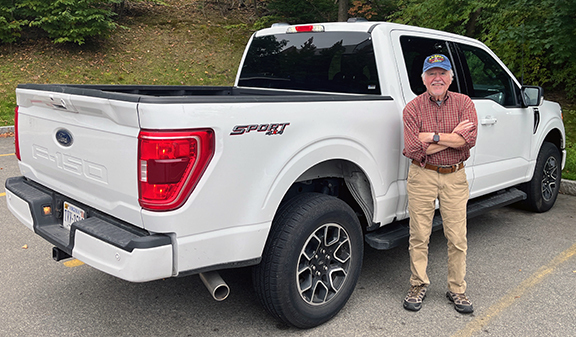
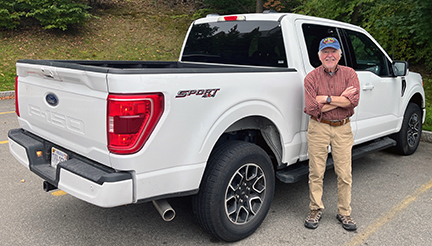
Did get to visit friends on the Cape, at BC, and in the Boston area. And, for the third year in a row, my rental car was a pickup! I reserve a inexpensive, small vehicle, but have had the opportunity to drive a pickup at no extra charge. This one was my first Ford 150.
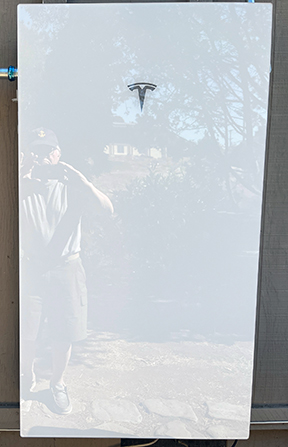
We also got a Tesla this year! Not the car, the PowerWall, a battery that stores power from our solar panels and distributes it when needed. I have a Power Purchase Agreement, meaning I “rent” the solar panels from a local company. The agreement is for 20 years and the rent never goes up. After five years, we can buy it if we wish. The fee also covers the cost of replacing half the shingles because the 50-year-old original set was not adequate and, even with that, we expect utility charges to be less than half our average monthly charge over the previous year.
My term as president of the Anza-Borrego Foundation comes to an end in January. I will remain on the board and hope to play a meaningful role in other ways.
Addy entered junior high school this fall and becomes a teenager officially in January, while Alice hits double digits in July. Meredith and Winter continue at the North County Boys & Girls Club and Charlie’s Foreign Auto, respectively.
Happy Hanukkah, merry Christmas, and happy New Year to you and your family. May your hopes come alive in 2025!
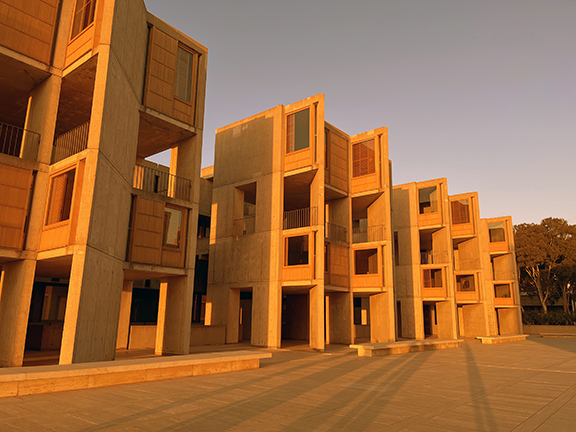
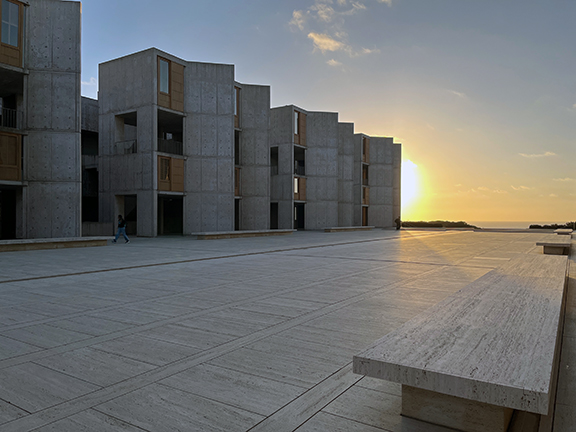
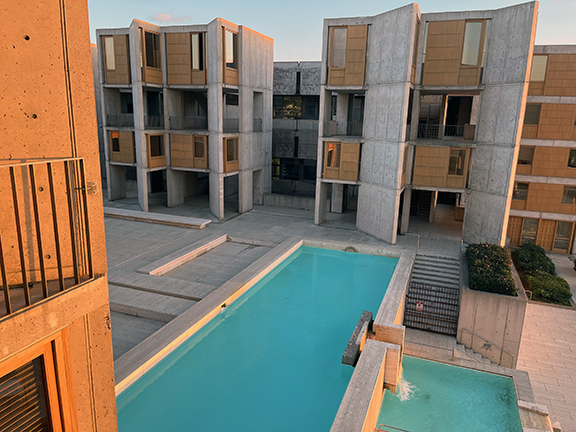
The setting sun lends a golden hue to the Salk Institute structures.
The Salk Institute for Biological Studies is one of the top few research institutes in the world. Founded in 1963 by Jonas Salk, developer of the first safe and effective polio vaccine in the 1950s, it is also an architectural marvel. And it’s in nearby La Jolla, on a bluff overseeing the Pacific Ocean.
I was fortunate to be among several Boston College alumni invited to join an architectural tour of the facility in late October. The tour was led by Lissa Tsu, leader of the San Diego Boston College alumni chapter and a docent at the Salk.
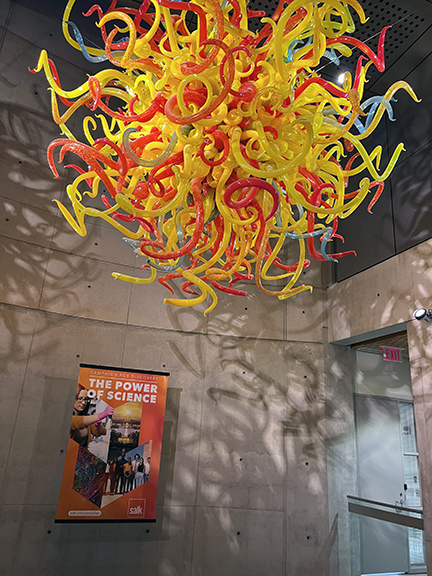
We first gathered inside, alongside the amazing glass sculpture by Dale Chihuly, representing the action within “The Sun.”
This post is going to be mostly photos, and you’ll see why, but first a little background. Salk never patented the vaccine he developed and earned no money from it, wanting it to be distributed as widely and freely as possible.
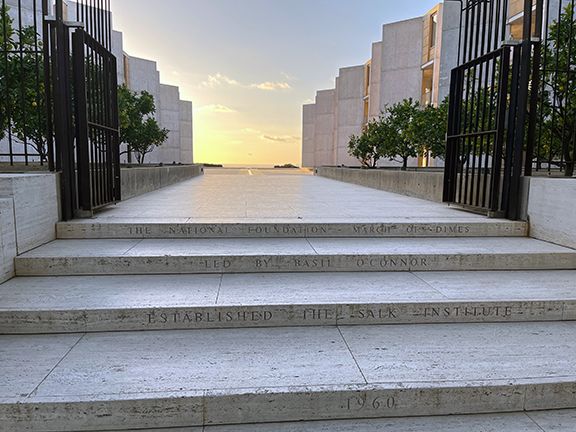
His desire to found a research institute to develop other medicines was supported financially by the National Foundation/March of Dimes and enabled further by the gifting of 27 acres in La Jolla by the City of San Diego. He partnered with architect Louis Kahn to design the research center. He directed Kahn to “create a facility worthy of a visit by Picasso.” It was completed and opened in 1963. Jonas Salk died in La Jolla in 1995 at the age of 80.
The entrance to the main campus.
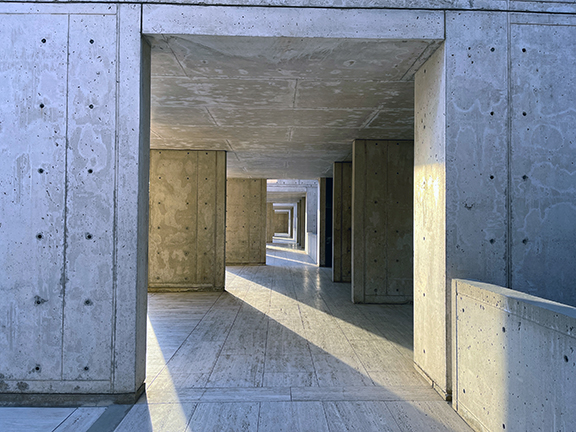
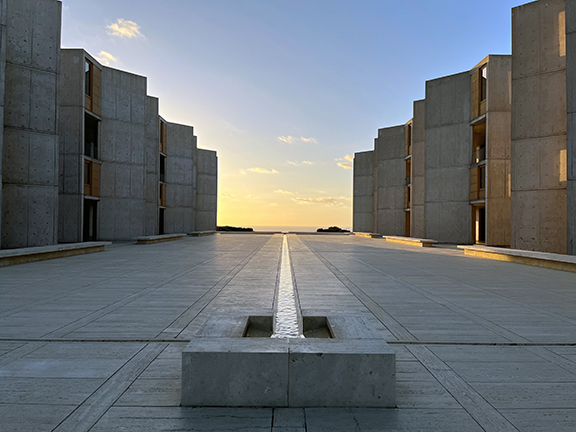
The sun plays a major role in the appearance of the buildings at the Salk. As the sun moves across the sky, it creates shadows and changes the appearance of the concrete and teak that form most of the buildings.
The structures contain several levels, some below “ground” level.
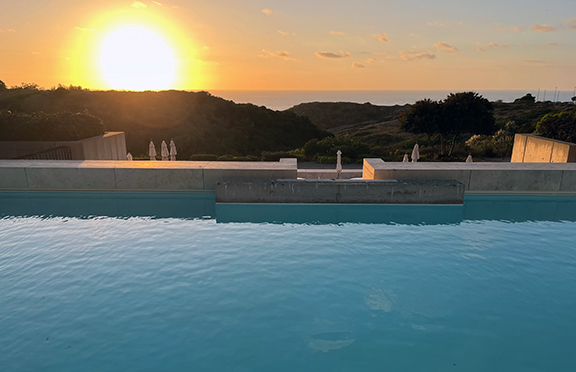
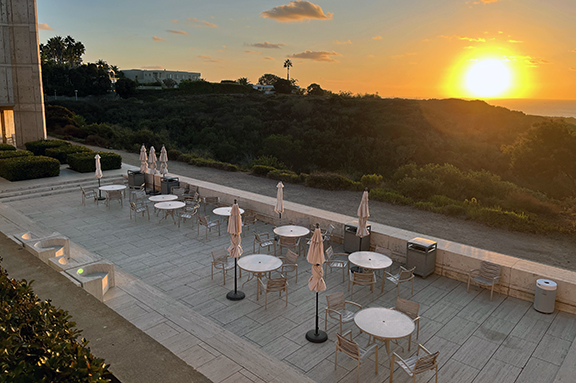
At the western end of the courtyard is a patio and pool . . . and wonderful view of the Pacific. We also lucked out by having our tour close to sunset.
There is a water feature that bisects the main courtyard. It’s called the “River of Life.”
Here it is “in action” (12 seconds).
There is a much more comprehensive and learned presentation of the Salk Institute architecture on its website. Below is the link to a “virtual tour” of the institute, offering videos on various aspects of the architecture.
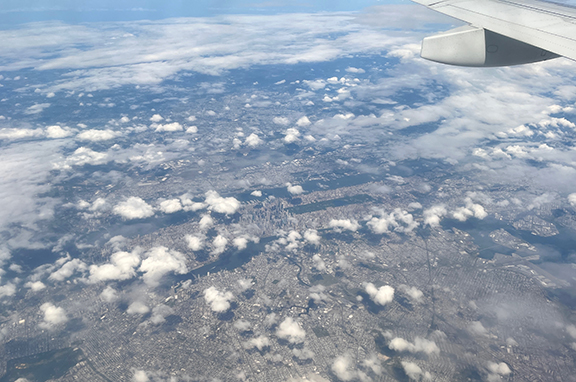
Aerial view of New York City I had never seen before. Right in the middle of the photo are the dramatic spires of Lower Manhattan.
Since moving to SoCal in 2012, I’ve joined Boston College classmates each year for a BC football game in Chestnut Hill or on the road, except for the initial COVID year of 2020. All the trips have included visits to family and friends in the Boston area and on Cape Cod. So, did it again in mid-September for the BC-Michigan State football game on September 21.
A wrinkle this time was visiting daughter Julia and son-in-law Sam in their new home in Arlington, Va. I had seen them the previous two years when they lived in Ypsilanti, Mich. For whatever reason, getting from San Diego to Washington, D.C., ain’t easy. Well, it isn’t difficult, just inconvenient.
The airlines I fly, for ease of visiting my friends and kids, are JetBlue and Delta. Neither airline offers a non-stop to DC from San Diego. Delta has a stop in Detroit and JetBlue has a stop and change of plane in Boston. ?? I took the redeye on JetBlue to Boston and an early flight from there to Reagan Airport. I realized soon after I arrived that I had never flown into that airport. I had always previously flown into Dulles, which is much farther from the city. Reagan is very convenient to the city and to Arlington.
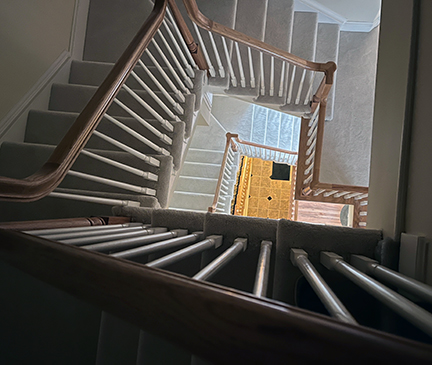
Stairways in Alexandria
As Julia and Sam had just moved in and their condo is small, I stayed with friends. Pat and Tom Sugrue are close friends and live in Alexandria, close to Arlington. It was “interesting” that my room in the Sugrues’ townhouse was on the fourth floor and Julia and Sam live in a fourth-floor walkup. During the three-plus days I visited, I set personal records each day in “flights climbed,” all in the mid-20s.
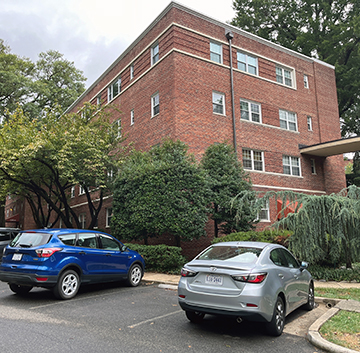
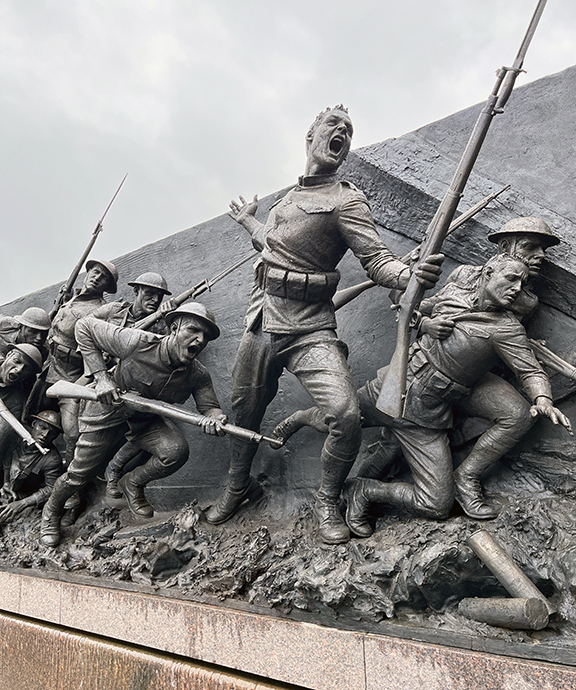
Julia and Sam’s place is on top floor.Segment of National World War I Memorial.
I had mentioned to Julia earlier that I was interested in seeing a new monument in DC. I had seen a feature about the National World War I Memorial on CBS Sunday Morning. It opened earlier in the fall, the most recent memorial and one commemorating US participation in a war more than 100 years ago. It’s a dramatic 58-foot long relief sculpture located in Pershing Park, dedicated to the US general who led American troops in the war.
The artist who created it said he wanted it to be realistic, as opposed to the more abstract memorials marking other conflicts. He said he wanted people to view and sense the mud, blood, and passion of the experience. The sculpture is called “A Soldier’s Journey” and shows different facets of the conflict and the diverse group of American soldiers who fought in it.
Here is a video of the dynamic sculpture (34 seconds). (Sorry for the occasional photo-bombing finger.)
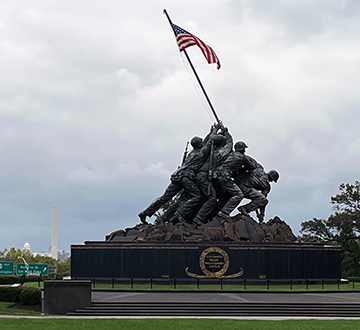
On our walk to the Metro to visit that first day, we passed the Marine Corps War Memorial, with its iconic sculpture of the flag-raising on Iwo Jima.
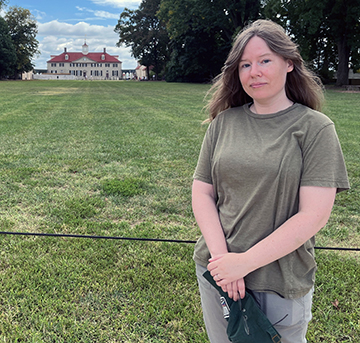
On my second day, Julia and I visited Mount Vernon, the mansion and expansive grounds occupied by George and Martha Washington, and many others, on the shores of the Potomac River just south of DC. While a national historic site, it does not have that status officially. The site is managed by the Mount Vernon Ladies Association, the same group that purchased it in 1854 following decades of its decline. Both Virginia and the US Congress had declined to preserve the site. It is sustained now by admission fees and donations.
Julia at Mount Vernon
Reportedly, George Washington said he could not think of a better location for a home and farm. It’s pretty nice.
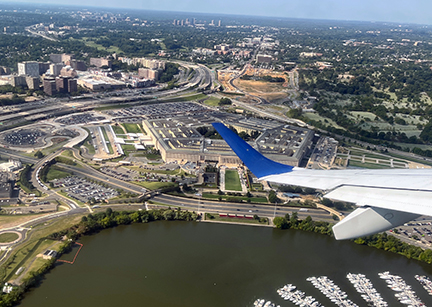
I left DC Friday morning, the day before the football game. Taking off, I realized we were flying close over the Pentagon and took a photo.
O’er the Pentagon
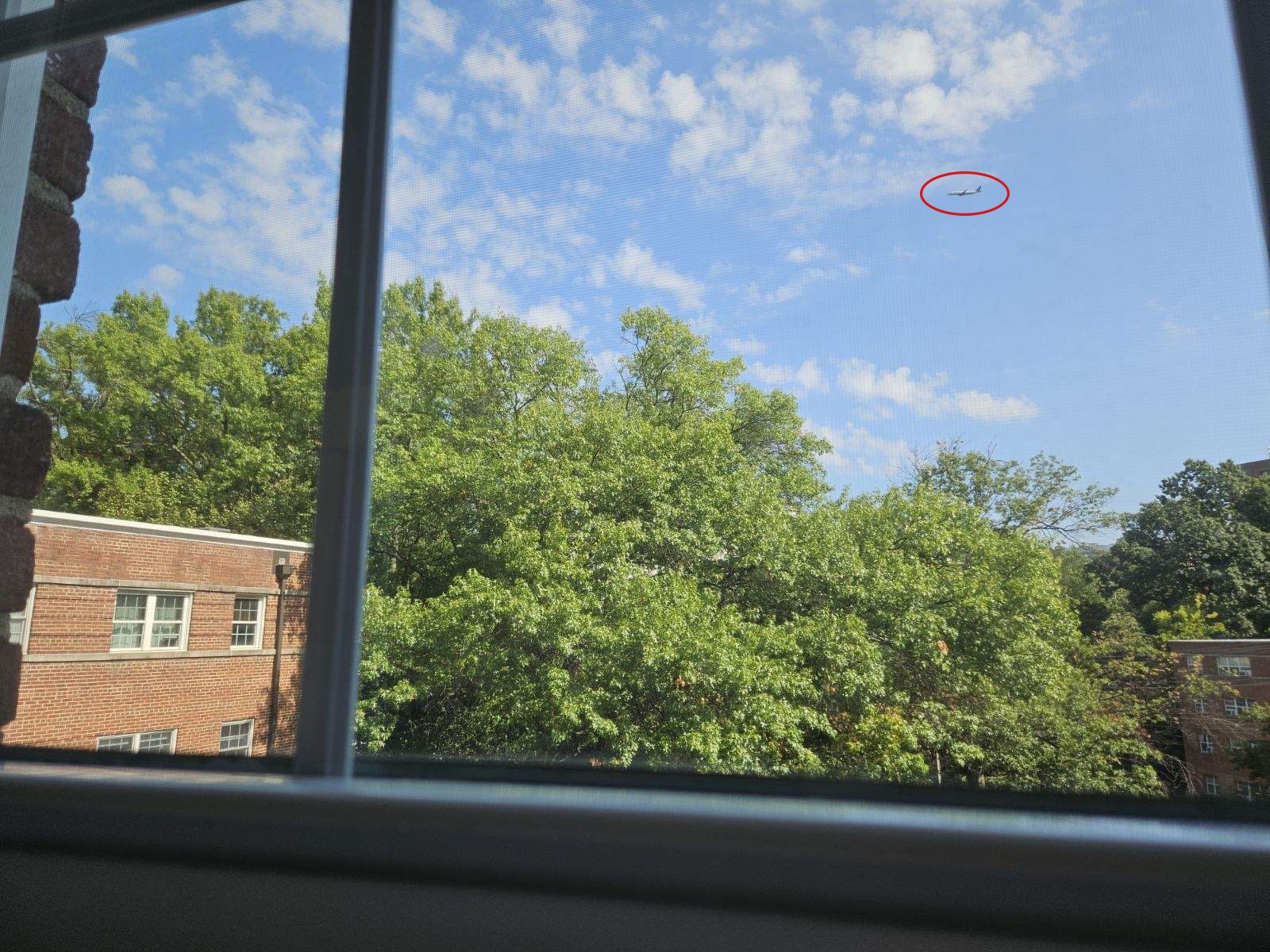
Julia was tracking my flight on Flight Aware, an app that lets you track flights in near real time. She saw that it was to fly over her location, looked out, and took a picture of the plane I was on as it passed overhead. I don’t think that has ever happened before with us.
That’s me up there.
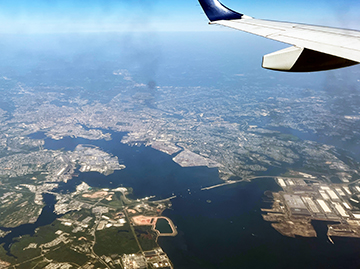
The earlier flight from Boston to DC had been mostly over the ocean. Because of weather conditions, I believe, the flight to Boston was much closer to the shore. I noted when we passed over Baltimore harbor and was struck by seeing its broken bridge in real life.
Not long after, I glanced out the window and saw a dark colored rectangle below amidst the clouds. Central Park?
Indeed it was. And it’s the photo at the top of this post.
Once in Boston I began my traditional bus, T, commuter rail journey to South Acton, adjacent to the Acton home of Marcy Kenah, my home base for the next several days. That afternoon, I joined Marcy, the Sugrues, Debbie and Ken Hamberg, Shelia and Dan Downey, Jackie Hewitt, and Ed Hattauer for a wonderful dinner and get-together.
The weather forecast for Saturday’s game, which was to begin at 8 pm, was not good. The previous year, the same group had been at West Point for the game with Army. It rained, often heavily, all day. We all got soaked and most of us left at halftime to return to the hotel on base to watch the game on television.
The group gathered that afternoon at Debbie and Ken’s condo on Commonwealth Avenue, near Kenmore Square, to lunch, watch afternoon games, and prepare for travel to Alumni Stadium. There was constant attention to weather forecasts, which varied from rain ending by game time to rain throughout.
The Acton contingent of Marcy, the Sugrues, and me ultimately chose not to attend the game, but to return to Acton to watch the game in a warm, dry living room. The others braved the elements and attended the game, with varying degrees of satisfaction. BC did, however, come back to beat Michigan State and the vibe of the crowd in the stadium was electric.
Sunday was the start of my visitation phase, aiming first for a visit to Plum Island and the cottage there of my cousin, Kathy Gagne McNanamy. I had made a reservation at the nearby Avis location in Maynard for an inexpensive subcompact car. When Marcy dropped me off, I saw that there were many more cars there than usual.
The young man who was manning the site said that because of so many cars he needed them to move fast and I could have any car in the lot at no extra cost. I looked around and, for the third year in a row, I was able to drive out in a pickup. The previous two had been Toyota Tacomas. This one was a Ford 15o XLT. Nice truck!
It was a wonderful afternoon and evening with Kathy, highlighted by a meal of lobster and sides, and the presence of Maureen and Tony Raymond. I had worked with Maureen at BC, where Tony also worked. Soon after starting work at BC in 2000, I had learned from Kathy that one of her sons had married the daughter of Maureen and Tony. At that point, I went to Maureen’s office and said, “I think we’re almost related.” And our relationship has been closer ever since.
Monday was the trek to the Cape, where I met up with Susan and Reid Oslin, my hosts at their home in West Dennis. That evening, we joined Karen and Richard Sullivan at the annual dinner occasioned by my annual visit. And I split the next morning just “visiting” with the Oslins and later with the Sullivans at their home in Mashpee.
As an indicator of this stage of my life and the lives of my contemporaries, I was sadly unable to meet with two other friends because of their health issues.
Back up in Boston, I visited with Tom Burke and then went to the BC campus. Because of the size of my truck :), I was again unable to use the campus parking garages. Visiting with our alumni liaison, Dara Garrison, at the Cadigan Center on the Brighton Campus, I was able to use a visitor parking space for the day.
Several other people at Alumni stopped to say hello, including Mark Benjamin, whom I had not seen in years. Mark and I had a pleasant reminiscence. Later, I had the chance to meet briefly with Bob Capalbo and also chatted with Lee Pellegrini, with whom I worked closely for many years.
On my final full day, I had the chance to see Leo DeNatale, old friend and best man at my wedding, and Nate Kenyon at the Law School. Spent much of the afternoon with Margaret Evans and Rob Sternstein, two very lively and lovely friends.
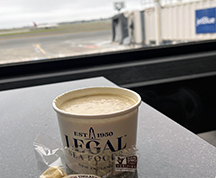
Traditional Legal Seafoods clam chowda at Logan Airport.
Back home, it was nice to be able to stay in one place for a while. I look forward very much to next year’s journey and the BC-Notre Dame game in Chestnut Hill! We also expect to have some “reverse action,” with classmates and friends coming West when the Eagles play Stanford.
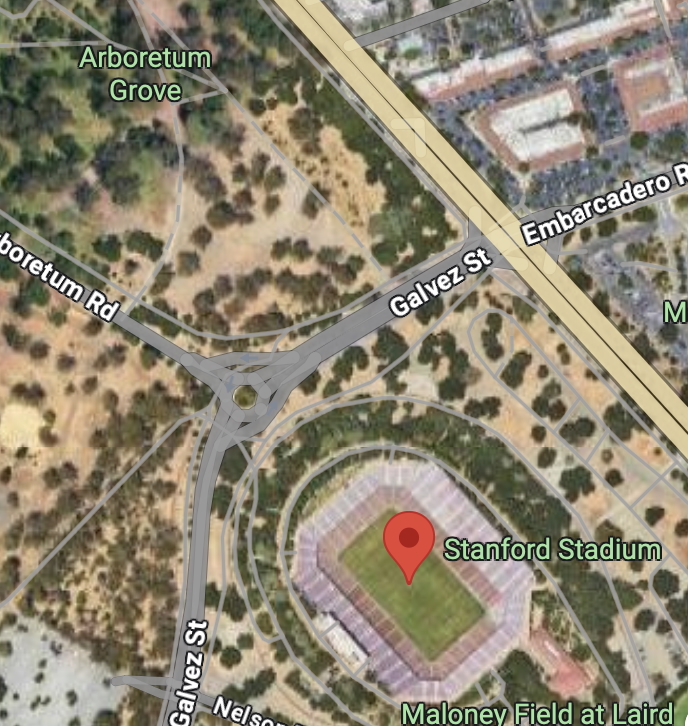 Instead of paved parking lots, the stadium is surrounded by groves of trees. Tailgaters park among the trees, which provide shade. It’s just a much more pleasant environment for a tailgate than an open field or parking lot.