Marines 250

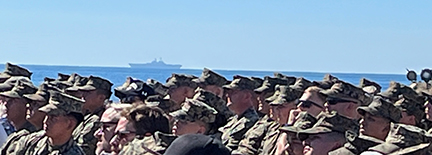
Ship silhouette off Camp Pendleton during Marines 250 event.

Back in mid-October, there was notice of a big celebration at Camp Pendleton to salute the 250th anniversary of the founding of the US Marine Corps. A live amphibious exercise, static displays, thousands of Marines, VIPs, etc. I had been invited years ago to observe an amphibious exercise there and it was impressive, but I thought the logistics for attending this one would be a problem.

Then I received an invitation to attend. With a pass and a procedure, which I thought would make things easier. Yeah, right.

The event was scheduled for 1200-1500 (noon-3 pm) October 18. The day before, I heard on the news almost weird information that the 5 freeway section that ran through Camp Pendleton might be closed during the amphibious exercise. It was related to a dustup between California governor Gavin Newsom and the Trump administration about the scheduling and manner of this event.

I was expected at the BC gamewatch that morning in downtown San Diego. I figured on attending that for about an hour and then head up north to Camp Pendleton. On my way south to San Diego on the 15 freeway, I saw road condition signs lit up with something like “Fed Gov Closure Fwy 5 11-3.” Wha??

On my way north at about 1000, I realized traffic was heavy because of people trying to get north on the 5 before it closed. This was the scene about 10 miles south of Oceanside and the southern edge of Camp Pendleton. The sign on right says “FED GOV. N 5 FWY CLOSURE AT SR 76 11-3 P” and, ominously, “LIVE WEAPONS OVER FREEWAY.”

I realized I was not going to get to Camp Pendleton on time by staying on the freeway. Getting off the freeway, I also realized a lot of other people were on its exits and entrances, creating traffic jams throughout. By getting past the jams and taking another entrance to the base, I was able finally to get on base and reach the commissary at about noon.

My shuttle to the event was leaving from the commissary and I thought I might have gotten on the last one, since the event was supposed to start at noon and the invitation asked that we get there early. In the first indication the event overall was less than militarily precise, it became clear the event would not start at noon.

The invitation had said that attendees would “see” a sea-to-shore amphibious exercise. But we were not brought to the beach where I had seen such an exercise earlier. We were brought to Del Mar Beach, a recreational area, and we would see the exercise on a video screen set up in a “stadium” on the sand.
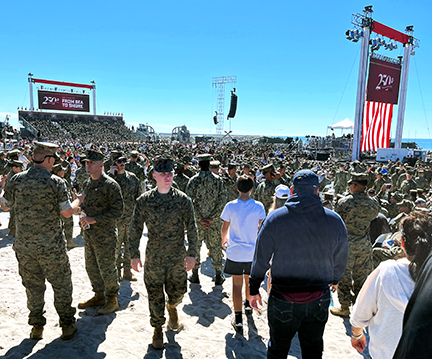
“Stadium” on the beach.

I had a good seat though. John Hernandez, a fellow Navy League officer and recently-elected junior vice commander of the California VFW, was a “special guest” for the event and had saved me a seat in the third row at the center of the event stage.
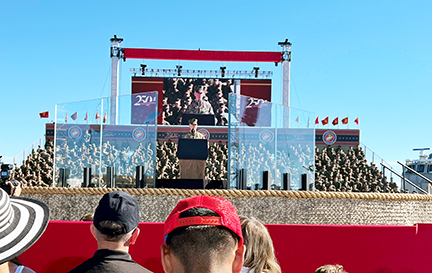
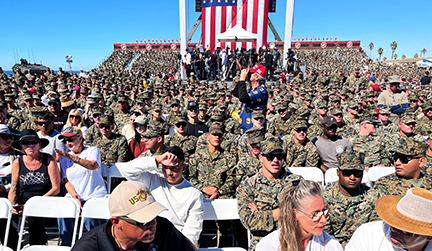
View from my seat during speech by Commandant of the Marine Corps.
Some of the crowd in the stadium. I don’t think I’ve ever been around so many Marines at one time. And there were thousands outside the stadium as well.

When the amphibious exercise finally got underway, around 1300, the narrator provided more bombast than information. At one point, with several artillery pieces on screen, the narrator said, “. . . and the roar of artillery began. THUNDER from the skies!” One howitzer fired. And then . . . nothing for several minutes. Then change of scene and topic.

Only later did we learn that the first projectile fired, over the now closed 5 freeway and aimed at an inland impact area, detonated prematurely. At least one piece of shrapnel hit and damaged a California Highway Patrol car parked on the freeway, part of the detail providing security for Vice President JD Vance. No one was injured, but the “thunder from the sky” stayed quiet thereafter.

Both the Marines and the Trump administration gave sometimes conflicting information about the decision to fire live artillery shells over the roadway. One report said the only previous time it had occurred was more than 70 years earlier, before the freeway had become an interstate highway.

Back in the stadium, the crowd was entertained by flyovers of some of the aircraft involved in the exercise. Here is a compilation of those (42 secs). At the beginning, the first jets were lower and faster, and louder, than the rest so they go by in a flash. That’s followed by them in “slow motion,” which does little to slow them.


Following the flyovers, the speeches renewed. When the emcee said the event was going to go on for “the next few hours,” I deferred. I was leaving when Secretary of Defense Pete Hegseth began to speak. I heard him say that, while he didn’t think he should say so, “You Marines are my favorite.” I bet that’s not the first time he’s said that to one service or the other.

Apparently, all this was for a special video broadcast on November 9, the day before the actual Marine anniversary. It also took place on the same day as the nationwide “No Kings” rallies opposing the Trump administration. What a coincidence.

For a less bombastic view of an amphibious exercise, this is a video (7:03) from the aforementioned exercise I attended on the actual beach at Camp Pendleton in 2017.
Jujube visit: Birch Aquarium

Jujube’s final visitor experience in May was at the Birch Aquarium, part of the Scripps Institution of Oceanography at UC San Diego.

We were joined on this trip by her nieces, Addy and Alice.

One of the main attractions at the aquarium is the recently-completed Scripps Living Seas Gallery, which displays several of the ecosystems and sea life of the Pacific.

Here is a sampling from that exhibit. First, fish . . . and some Garden Eels, which look like worms in sand. (The videos in this post can also be viewed on YouTube. Just click on “YouTube” at lower right.)

Also, jellyfish.

A small ray provided viewers a lot of enjoyment doing something that seemed to give it some enjoyment as well. It spent several minutes repeatedly seeming to climb up the tank and then glide down. On the video below, you can also hear a young child urge it on.

The aquarium also offers an extensive selection of seahorses and seadragons. Here are some.

Jujube and the nieces spent a lot of time at “Blue Beach,” an activities space at the Aquarium. There, they used available materials to build small boats and test their seaworthiness in a flowing stream.

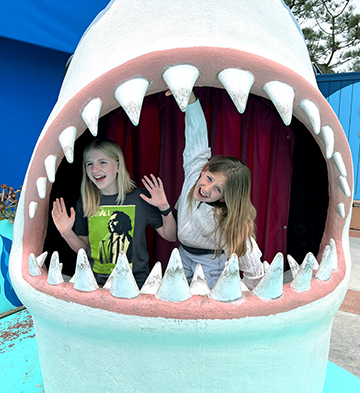
The nieces also fulfilled an Aquarium-visit requirement at Blue Beach by posing in the shark’s mouth.

Another distinctive exhibit at the Aquarium features Little Blue Penguins, native to New Zealand and southern Australia. They’re the smallest penguins, generally growing up to 10 inches tall and three pounds in weight. They don’t live in snow, but on coastal dunes and rocky shores.

I enjoy watching octopuses, but rarely see them in action. Often, they seem to be avoiding public view, up in a corner of their space. Not on this visit!  Got to see one in action, moving across the tank.

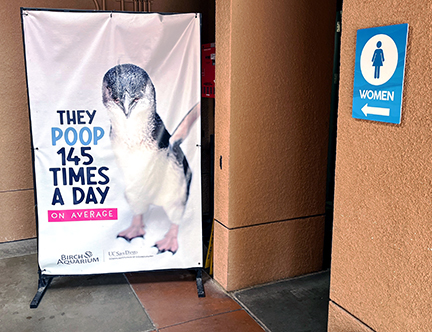
Finally, on the way out with a stop at the restrooms, noticed this sign. I assume “they” are penguins, not women.

Jujube visit: Cassowary and platypus

On Tuesday during Jujube’s visit in late May, she and I made a brief visit to the San Diego Zoo Safari Park in Escondido. They had added a Walkabout Australia section since she had last visited.

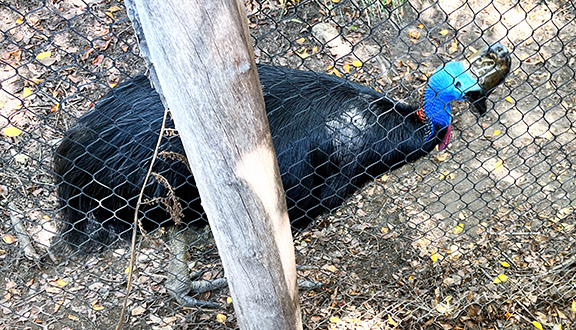
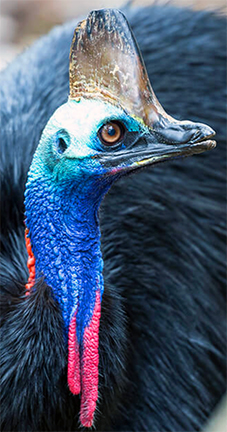
There we were able to see a cassowary (above), a large flightless bird most closely related to the emu. They’re native to Northern Australia, New Guinea, and nearby islands. Emus are taller than the cassowary, which is 4-5 feet tall, but the cassowary is the heaviest bird in Australia and second heaviest, to the ostrich, in the world.

Among the unusual features of the cassowary is its casque (helmet) atop its head. While distinctive, its purpose is uncertain. According to the Zoo’s website, the casque is “made of a sponge-like material and covered with a thick layer of keratin, the same thing our fingernails are made of. Although it is quite sturdy, the casque can be squeezed in the middle fairly easily.”

Two of the three cassowary species have “wattles,” fleshy pouches of skin hanging from the neck. They are colored blue, red, gold, purple, or white, depending on the species or subspecies. Again, the purpose is uncertain.

The cassowary is most active at dawn and dusk, so we were fortunate to view ours in motion and relatively nearby. To get a better view, the photo at left is from the Zoo website. 

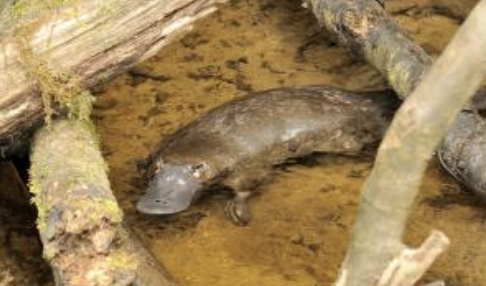
Also visited the platypus exhibit. The Safari Park is the only zoo outside Australia to have platypuses. They are nocturnal, so their exhibit is darkened during zoo hours, and it is difficult to see them clearly.

The platypus is an egg-laying mammal, one of only five such species. Again, we’re going to use a photo from the Zoo website.


Jujube visit: Gold mine

Winter and Addy lead the way to gold.

During her visit in May, Jujube (my daughter’s nickname) suggested a visit to a gold mine in Julian, a historic community in the mountains of East San Diego County, at about 4,200 feet elevation. Julian is an official California Historical Landmark due to its role in the 19th century California gold rush.

Our guide at the mine said Julian in 1869 was site of the last of the “gold rushes” in California, with the first being THE California gold rush of 1848, when gold was discovered at Sutter’s Mill in Coloma, 35 miles northeast of Sacramento. That discovery brought about the largest mass migration in U.S. history. 

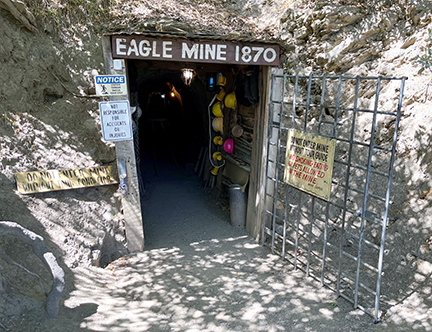
Parking in “downtown” Julian, we walked up to the Eagle Mining Co., which offers tours of its mine and gives an orientation to panning gold.

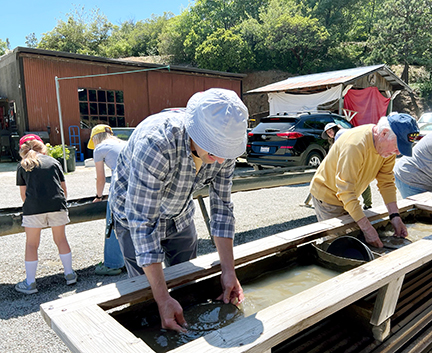
Winter and I, with Addy and Alice at rear, pan for gold.
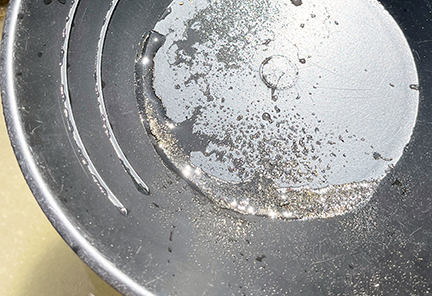
Tiny, shiny bits of gold in Julia’s pan.

Guests can pan for real gold, but you don’t get to keep what you find. Best anyone can do is find a few flakes, which Winter and I found. Jujube’s pan, however, was a little better.

Then we entered the mine, which had been created in 1870, for a tour of about an hour’s duration. You don’t do down into the mine, you enter directly into the side of the mountain at what the guide was the seventh level of the mine, with six levels below and at least one above.

The guide warned tour participants that some might feel claustrophobic because of the narrow and low tunnels. (Post tour, we all agreed we didn’t feel claustrophobic, but did occasionally wonder what would happen if there was an earthquake while we were there.)

This video gives a “hint” of what it was like in the mine.

At one point, the guide lit a candle that had been put along the tunnel wall, and then turned off the electric lights, to show us something like the condition for mine workers in the 1800s. Then he extinguished the candle and we were in darkness as total as I had ever been in.

At the end of the tour, we went up one level to exit from higher up on the mountain side. 

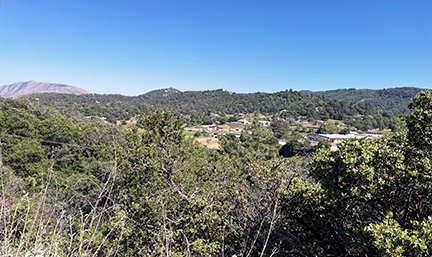
View from the exit level.

The guide, as I recall, said the value of the gold extracted during the active life of the mine was several million dollars in today’s currency.

Complicated directions back to town.

Salk walk

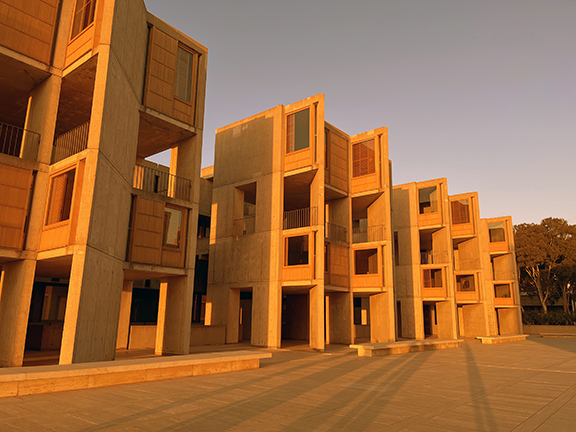
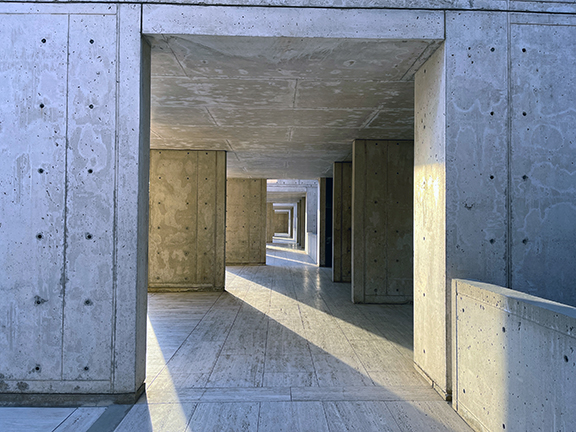
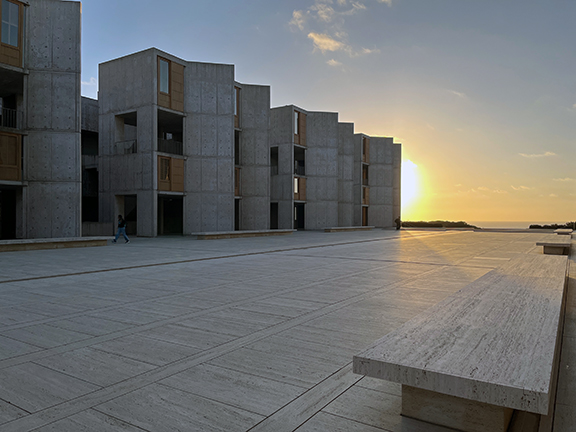
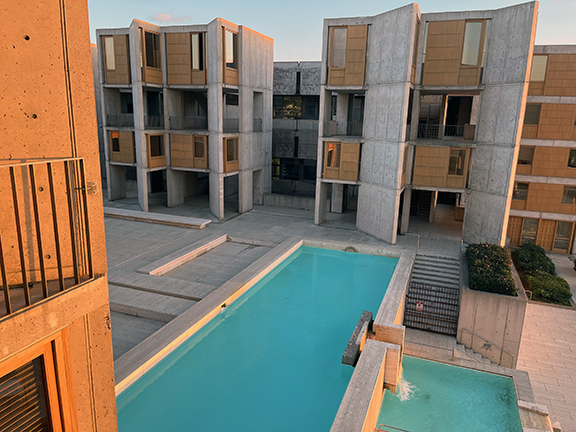
The setting sun lends a golden hue to the Salk Institute structures.

The Salk Institute for Biological Studies is one of the top few research institutes in the world. Founded in 1963 by Jonas Salk, developer of the first safe and effective polio vaccine in the 1950s, it is also an architectural marvel. And it’s in nearby La Jolla, on a bluff overseeing the Pacific Ocean.

I was fortunate to be among several Boston College alumni invited to join an architectural tour of the facility in late October. The tour was led by Lissa Tsu, leader of the San Diego Boston College alumni chapter and a docent at the Salk.

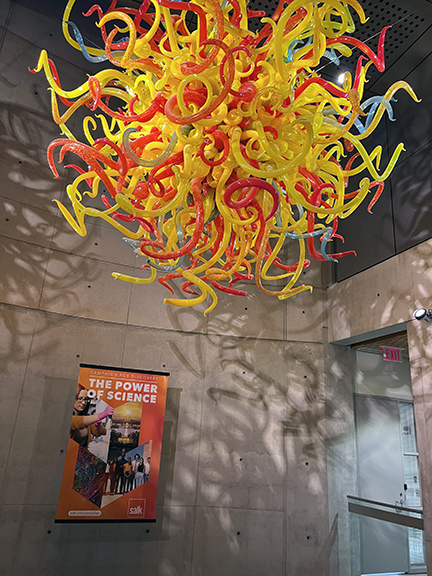
We first gathered inside, alongside the amazing glass sculpture by Dale Chihuly, representing the action within “The Sun.”

This post is going to be mostly photos, and you’ll see why, but first a little background. Salk never patented the vaccine he developed and earned no money from it, wanting it to be distributed as widely and freely as possible.

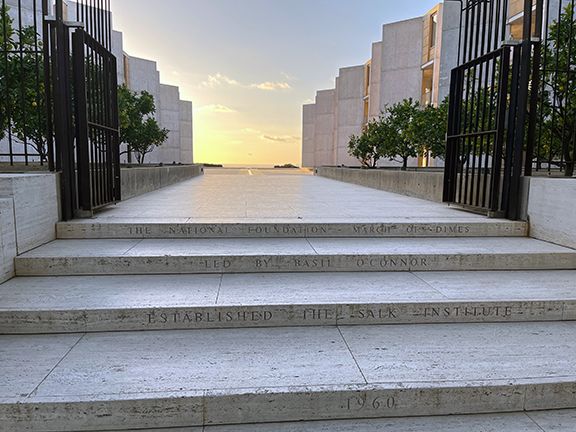
His desire to found a research institute to develop other medicines was supported financially by the National Foundation/March of Dimes and enabled further by the gifting of 27 acres in La Jolla by the City of San Diego. He partnered with architect Louis Kahn to design the research center. He directed Kahn to “create a facility worthy of a visit by Picasso.” It was completed and opened in 1963. Jonas Salk died in La Jolla in 1995 at the age of 80.

The entrance to the main campus.

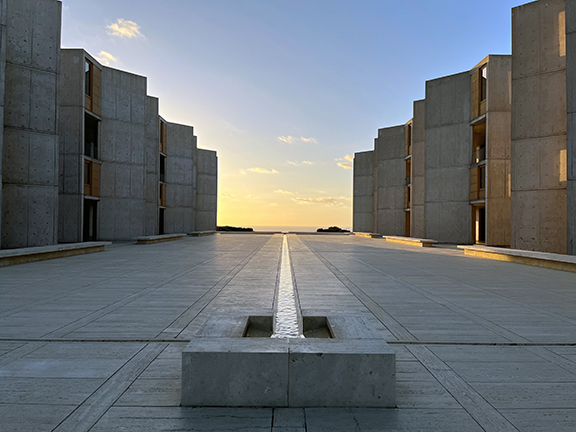
The sun plays a major role in the appearance of the buildings at the Salk. As the sun moves across the sky, it creates shadows and changes the appearance of the concrete and teak that form most of the buildings.

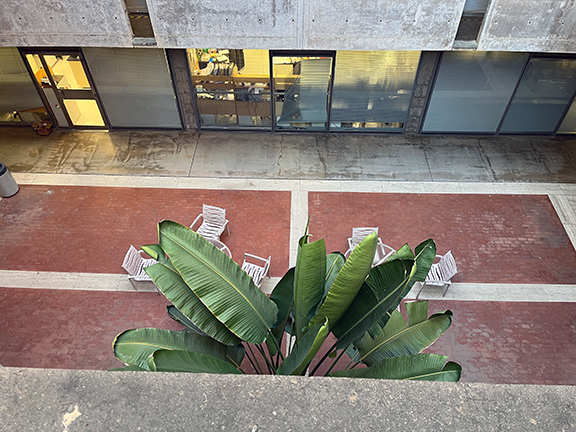
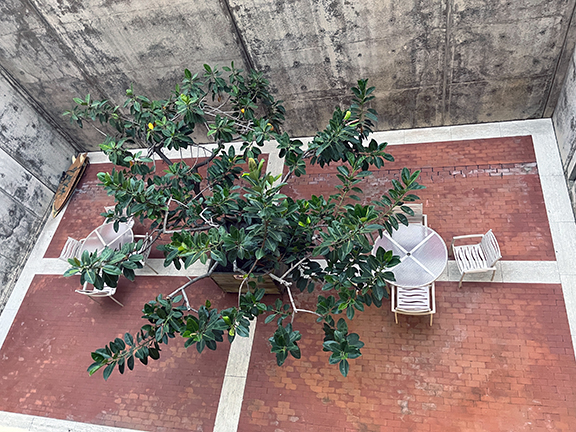
The structures contain several levels, some below “ground” level.

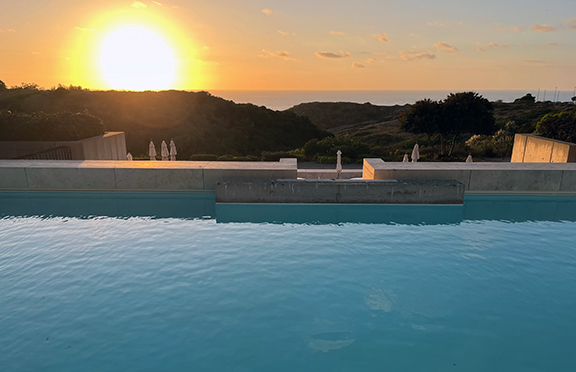
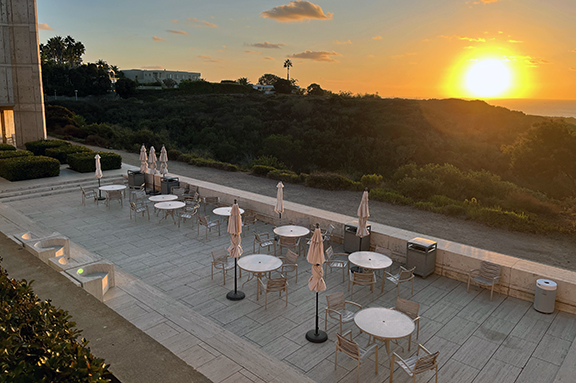
At the western end of the courtyard is a patio and pool . . . and wonderful view of the Pacific. We also lucked out by having our tour close to sunset.

There is a water feature that bisects the main courtyard. It’s called the “River of Life.”

Here it is “in action” (12 seconds).

There is a much more comprehensive and learned presentation of the Salk Institute architecture on its website. Below is the link to a “virtual tour” of the institute, offering videos on various aspects of the architecture.

Virtual Tour


Honoring Lowell

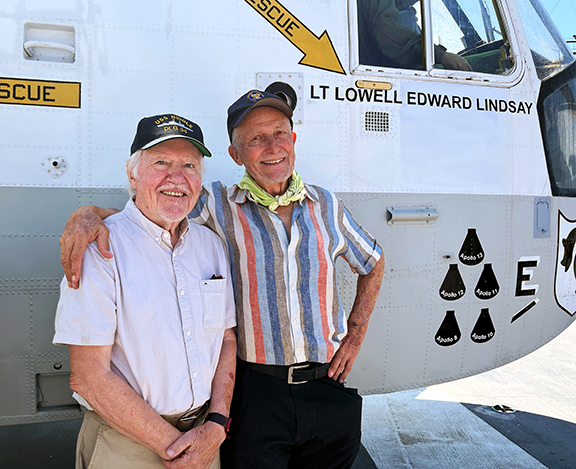
I had the privilege of attending a ceremony aboard the USS Midway Museum Friday, August 2, to honor Lowell Lindsay, a fellow Navy veteran.

Lowell and his wife, Diana, ran Sunbelt Publications, publishers of many volumes on the natural sciences, historical and cultural issues, and the San Diego region,  for more than 30 years. Diana has a long association with the Anza-Borrego Foundation, serving as its President and as a long-time member of its Board of Trustees. I’ve been an ABF trustee for about a dozen years and President for the past four years.

In recent years, I’ve had the pleasure of getting to know the Lindsays. Conversing about our earlier years, Lowell and I came to realize we each served in the Navy in the Gulf of Tonkin, off the coast of northern Vietnam and southern China, in the summer and fall of 1969.

Lowell was a helicopter pilot, serving various roles, such as search-and-rescue, and conveying personnel and supplies among the ships in the Gulf. I was stationed on the USS Biddle (DLG-34), a guided missile “destroyer leader,” later classified as a cruiser. It’s possible, Lowell and I realized, that he may have landed on the Biddle as part of his duties.

Among the aircraft carriers his squadron operated from was the USS Midway and on the flight deck of the USS Midway Museum now is the actual helicopter he piloted.

Last fall, Diana had invited me to join her, Lowell, her son, and a couple of friends on a VIP tour of the Midway Museum that she had won in a raffle. I had posted about it. During the tour, Diana said later, she noted the presence of a pilot’s name on “Lowell’s helo.” She inquired about how Lowell’s name might be added. And then she brought it about.

She wanted to keep it a surprise for Lowell, however. Guests to the event on August 2 were aware of what was about to happen, but Lowell was kept unaware. He knew the event was to celebrate his and Diana’s 60th wedding anniversary. Which it was, as well.

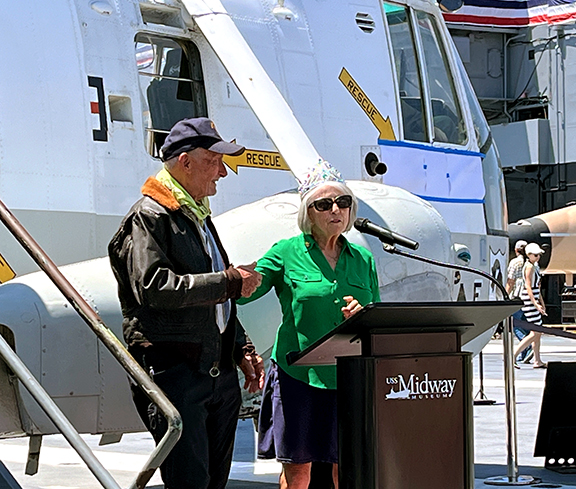
Lowell and Diana at the lectern. Note the covering — blue stripes top and bottom — below the window of the helicopter.

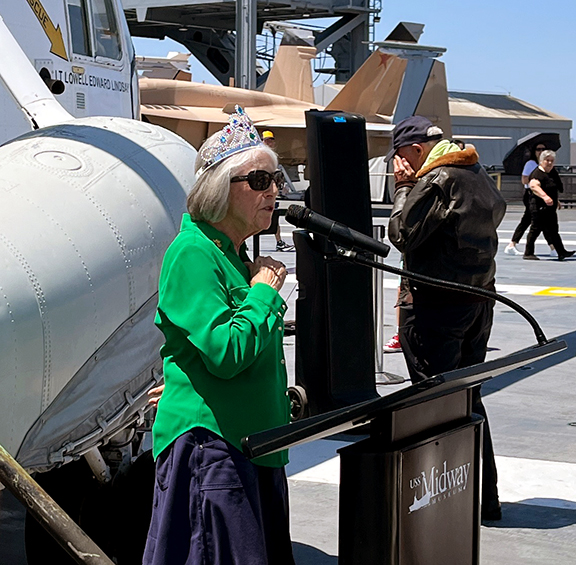
At the lectern next to the helicopter, and before the collection of family and friends on the Midway flight deck, Diana talked about the couple’s anniversary and then directed Lowell’s attention to the helicopter. Below the window at the pilot’s station was a sheet of paper, evidently placed there to cover something. She urged him to remove it.

When Lowell removed the paper, he became quietly emotional (at right), while the group cheered. Under the window, it now read “LT LOWELL EDWARD LINDSAY.”

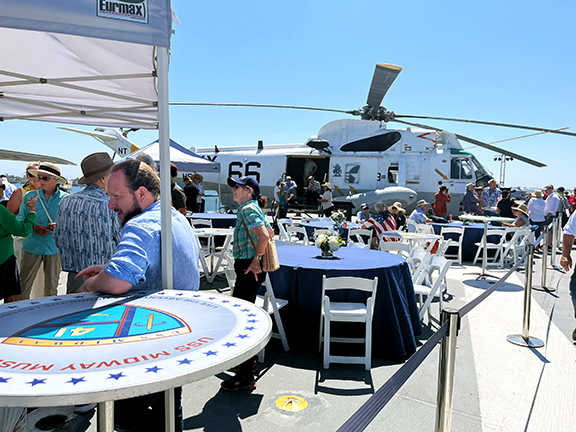
The rest of the afternoon was filled with “sea stories,” reminiscences among Lowell and fellow squadron mates, and hearty congratulations to Lowell and Diana.

The scene on the flight deck.

Bravo zulu, LT Lindsay! And Diana!

The USS Midway Museum is berthed alongside the Navy Pier in San Diego Harbor. It is one of the most-visited attractions in San Diego and the most-visited maritime museum in the United States.

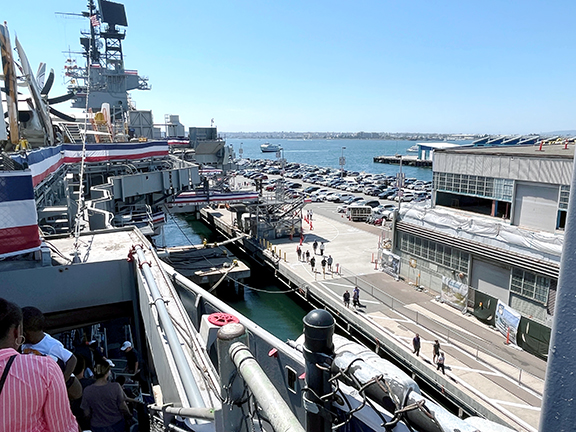
The flight deck offers four acres of open-air space 50 feet above the bay. It is the site of many events and spectacles.

To give a sense of the height of the Midway flight deck above Navy Pier.

On board

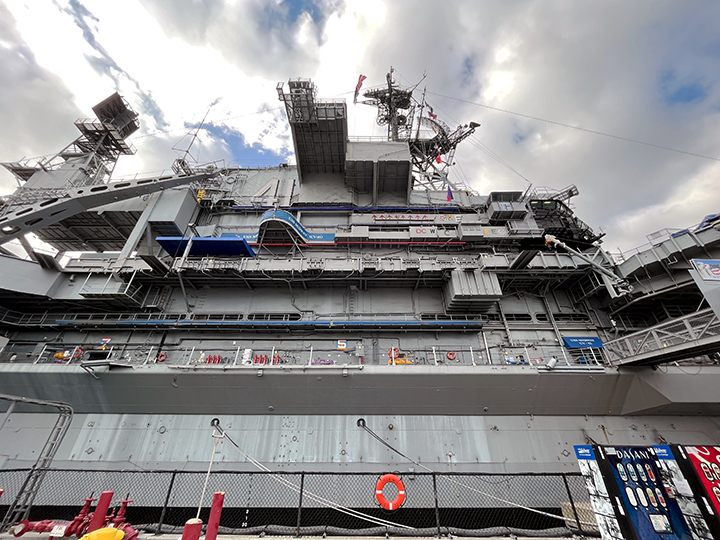
The Midway’s “island,” the superstructure above the flight deck containing command and control spaces.

On September 30, I had the honor and privilege to join Diana and Lowell Lindsay on a VIP tour of the USS Midway Museum, berthed in San Diego Harbor. Diana had won the tour in a raffle and the prize allowed her to have five people join her. She invited me to be among them.

A couple of years ago, Lowell and I had learned that, during our service in the Navy, we had both served in the Gulf of Tonkin, off the coasts of northern Vietnam and southern China, during the summer and fall of 1969. He was a helicopter pilot, shuttling people and supplies among the ships in the Gulf, and I was intelligence officer on a destroyer.

The tour allowed us to go on the ship an hour before its formal opening, permitting access to spaces that would later be filled with tourists and museum visitors. A museum volunteer, a former Naval aviator, was our personal guide. And we would end the tour with a meeting with the museum chief executive officer, who would then treat us to lunch.

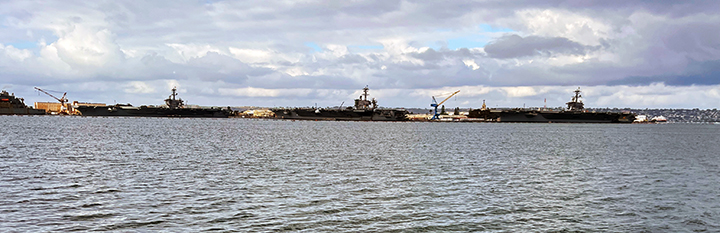
Arriving a bit early, I walked along the pier at which the Midway is berthed. Looking across the harbor to Naval Air Station, North Island, I was surprised to see all three aircraft carriers homeported at North Island lined up. Usually at least one of them is deployed.

USS Theodore Roosevelt, USS Abraham Lincoln, and USS John C. Stennis.

To give some background on this distinctive museum, the USS Midway (CVA-41) was commissioned eight days after the end of World War II, in September 1945. It had been named for the landmark victory by the US Navy in the area of Midway Island in 1942. Midway was the largest ship in the world until 1955.

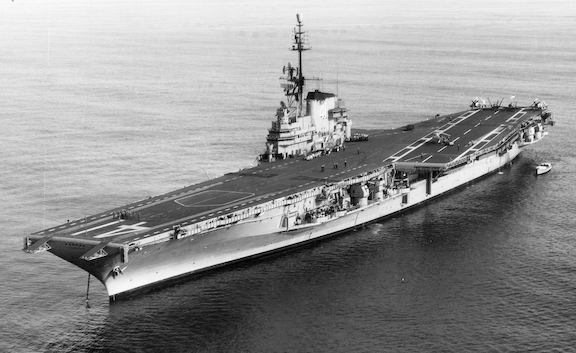
In more than 46 years active service, Midway saw action in the waters off Vietnam and in the Persian Gulf during Operation Desert Storm, in addition to many deployments to the Mediterranean and Western Pacific. It was modernized several times during service, including the addition of an angled flight deck in 1957. The photo below shows the ship in 1958.
Decommissioned in 1992 in San Diego, Midway was put into storage in Bremerton, Wash. Many ship veterans and those who flew off it over the years organized efforts to make the ship a floating museum in San Diego, the birthplace of Naval aviation. The Navy donated the ship in 2003 to the non-profit San Diego Aircraft Carrier Museum foundation. Thousands of volunteers made the ship accessible to visitors, prepared exhibits, and more. The USS Midway Museum opened to the public in June 2004.

Despite doubts by many about chances for success, Midway has developed into one of San Diego’s most popular attractions. More than a million people visit it each year.  TripAdvisor says Midway is the fourth most popular museum of any kind in the U.S.

Among our group was Jon Lindsay, son of Diana and Lowell, and he and I had another Navy connection. Jon was also an intelligence officer. On active duty, he had served in Iraq, working with SEAL teams 1 and 4. In 1970-71, I had served on the staff of Naval Special Warfare Group, Pacific, which was the command over SEAL and Underwater Demolition teams, in Coronado.

A Stanford grad, Jon also received a master’s there in computer science and later earned a PhD in political science from MIT. A retired Lieutenant Commander, he is associate professor at the School of Cybersecurity and Privacy at Georgia Tech. He’s the author of Information Technology and Military Power (Cornell, 2020) and co-author and editor of other works. So there the similarities diverge.

Also in the group were Greg Cranham, a local fellow geologist with Lowell, and Jean Billings, whose husband had served with Lowell in the same helicopter squadron.

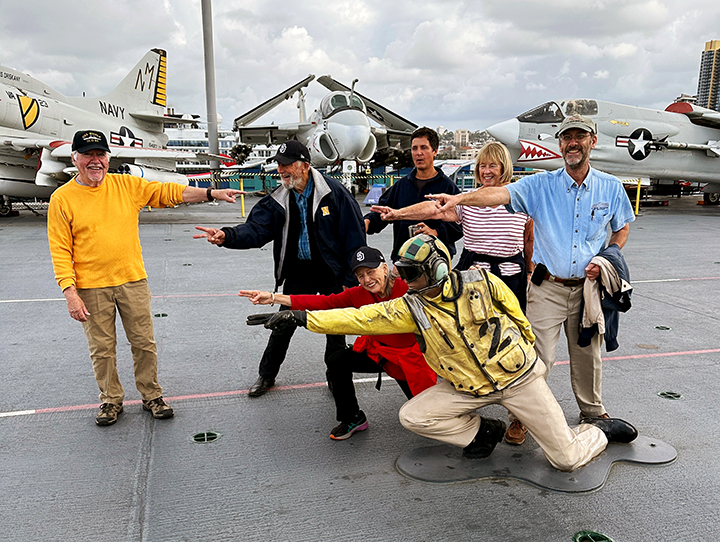
Emulating the carrier flight deck “shooter” in front are Diana Lindsay, kneeling, and behind her, from left, Lowell Lindsay, Jon Lindsay, Jean Billings, and Greg Cranham. As usual, I’m going in the wrong direction.

Below are scenes from the tour.

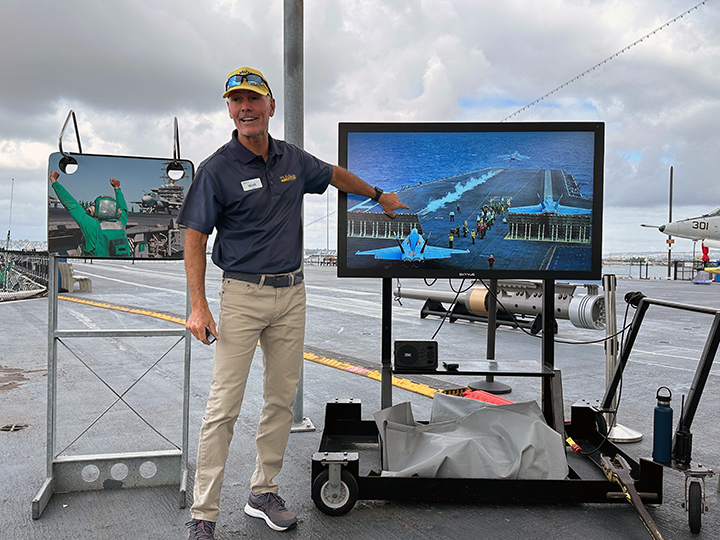
Retired Naval aviator Walt Glenn was our guide and provided a detailed briefing about launch operations.
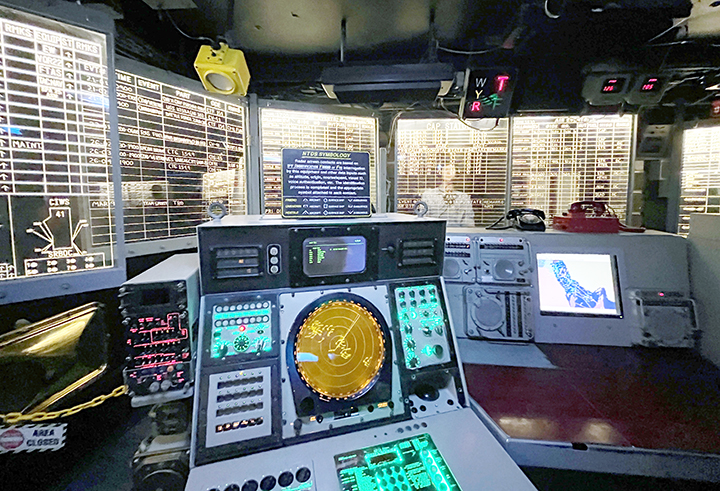
Air operations center
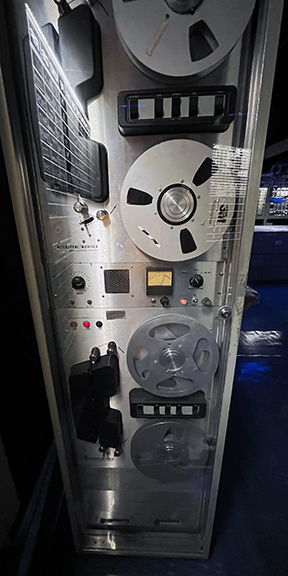
A “computer,” c. 1992
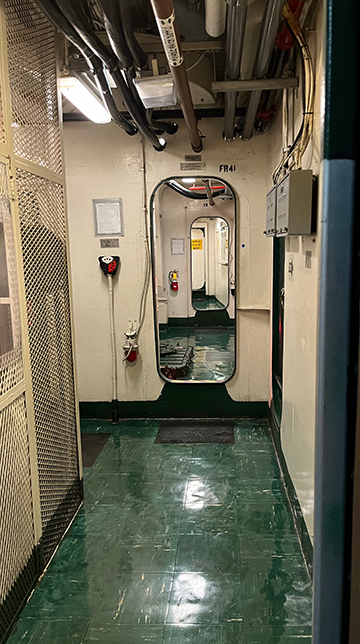
Passageway. Don’t trip.
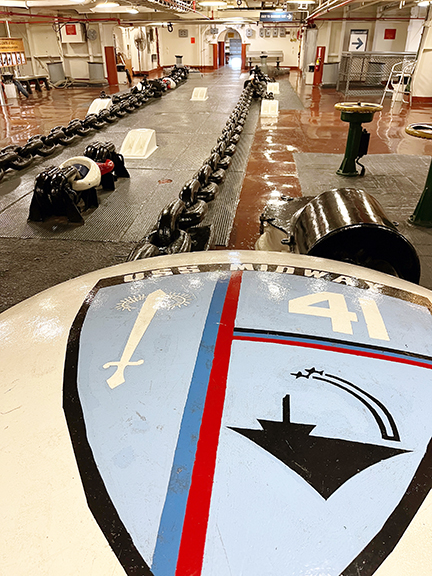
Huge anchor chains

Later, as we joined a group of “regular” visitors about to go to the top levels of the “island,” we received a briefing, which included warnings about the steepness of the ascent. Standard Navy “ladders” connecting decks were converted to stairs in much of Midway to accommodate a wide range of visitors. That was not possible in the narrow superstructure.

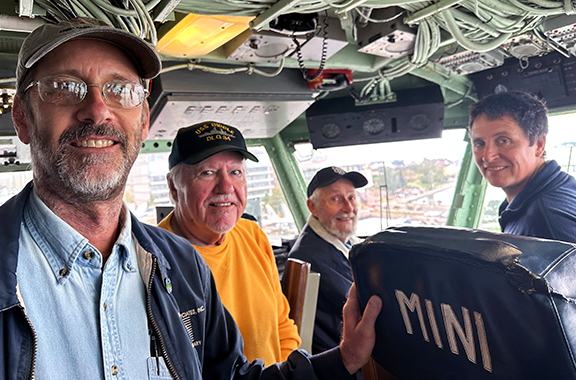
As the volunteer concluded his briefing, he pointed to me and said, “And you’re going to lead the way.” I looked puzzled, I expect, until he added, “Because you’ve done it before.” I was wearing a ballcap with the name of my ship — USS Biddle DLG-34 — on it. Indeed, I had done it before . . . many, many times.

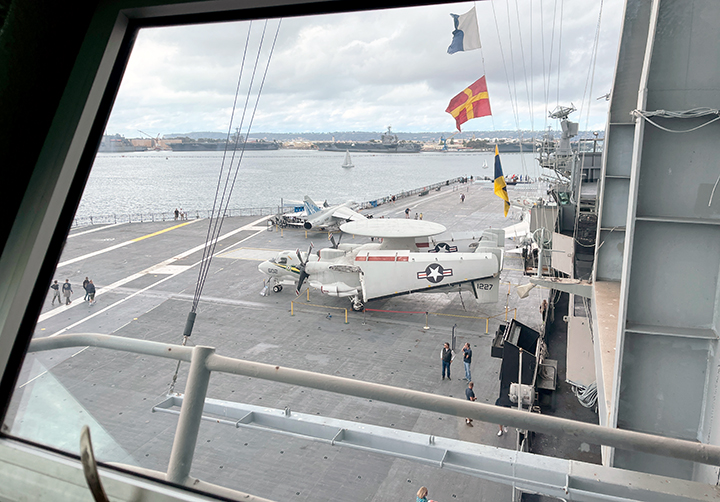
Some scenes from the bridges above the flight deck.

View from the Air Boss bridge.
Too many Air Bosses.

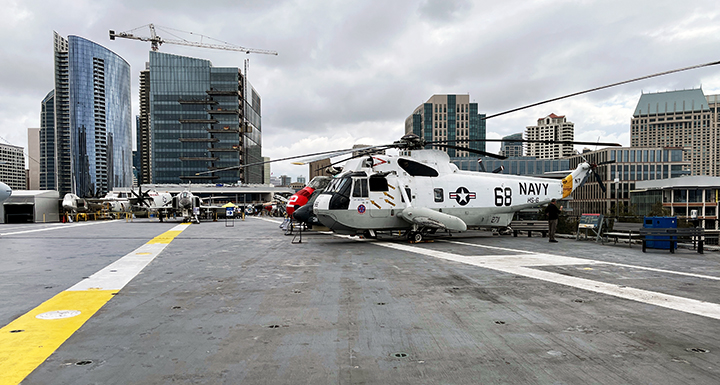
Back on the flight deck, I learned about what I thought was the most amazing aspect of the visit. I was aware that Lowell had flown off Midway during his tour in 1969, but I had no idea the helicopter he piloted was among those on exhibit on Midway. Number 68 in the picture below was Lowell’s bird.

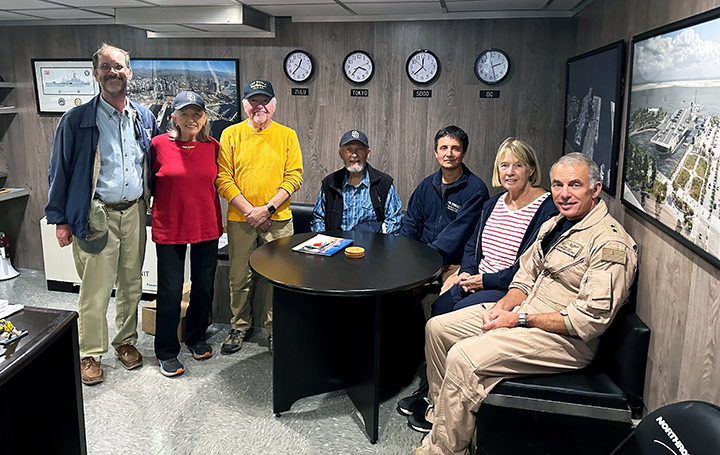
The penultimate phase of our tour was a meeting with Rear Admiral Terry Kraft (Ret.), chief executive officer of the USS Midway Museum. A graduate of the Naval Academy and former commanding officer of USS Ronald Reagan (CVN-76), Kraft was named CEO earlier this year. We met with Admiral Kraft in his office onboard.

L-R: Greg Cranham, Diana Lindsay, me, Lowell Lindsay, Jon Lindsay, Jean Billings, and Admiral Kraft.

He also told us about the museum’s plan to develop a $62-million park adjacent to the ship. The 3.6-acre “Freedom Park” will include a bay-view promenade and amphitheater.

Admiral Kraft and a rendering of the projected “Freedom Park” adjacent to the ship.

Initial work on the project is to begin in 2024, with completion scheduled for 2028.

And, to top off the morning, lunch — compliments of the CEO.

It was a fine Navy day and a wonderful way to mark Lowell’s 82nd birthday!

Visitors

In late February, two dear friends — Larry and Marcy Kenah — visited. They’re residents of Acton, Mass., had gone out to Bend, Ore., to join family celebrating their nephew’s 50th birthday, and decided to venture south.

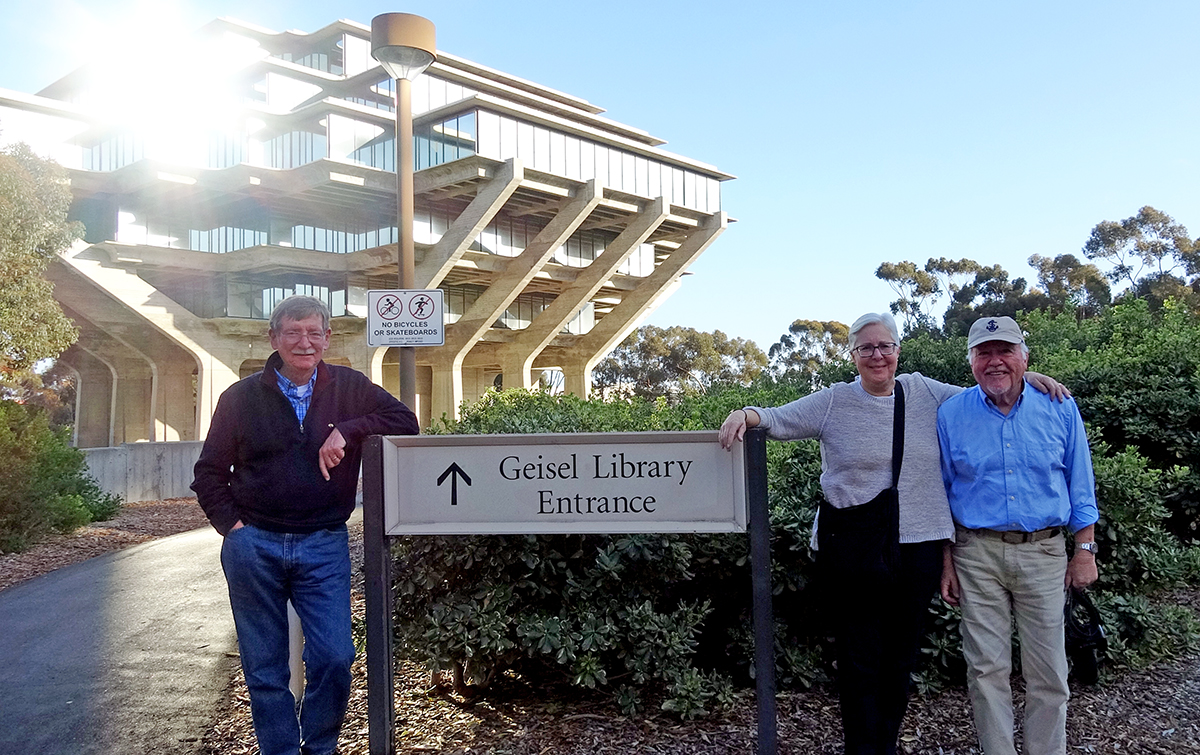
In front of UC San Diego’s Geisel Library.

I picked them up at the airport early afternoon on February 24 and we went for lunch at Stone Brewery Bistro in Liberty Station. I took the “long” way home after that so they could see more of inland San Diego. Our first stop, though, was UC San Diego, to see the Geisel Library there (named for Theodor Geisel, “Dr. Seuss” and a native of my hometown, Springfield, Mass.). It’s one of San Diego’s iconic buildings.

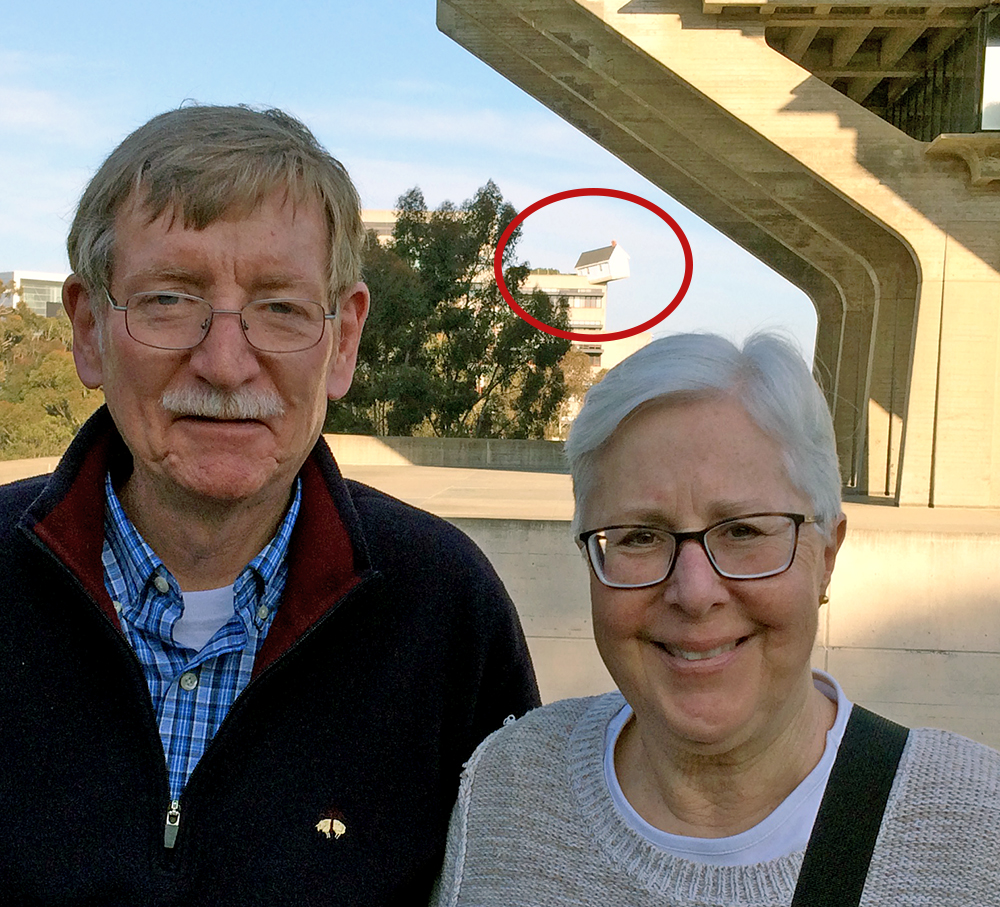
There’s also a bit of surprise behind the library. Here’s a photo of Larry and Marcy with the “surprise” circled.

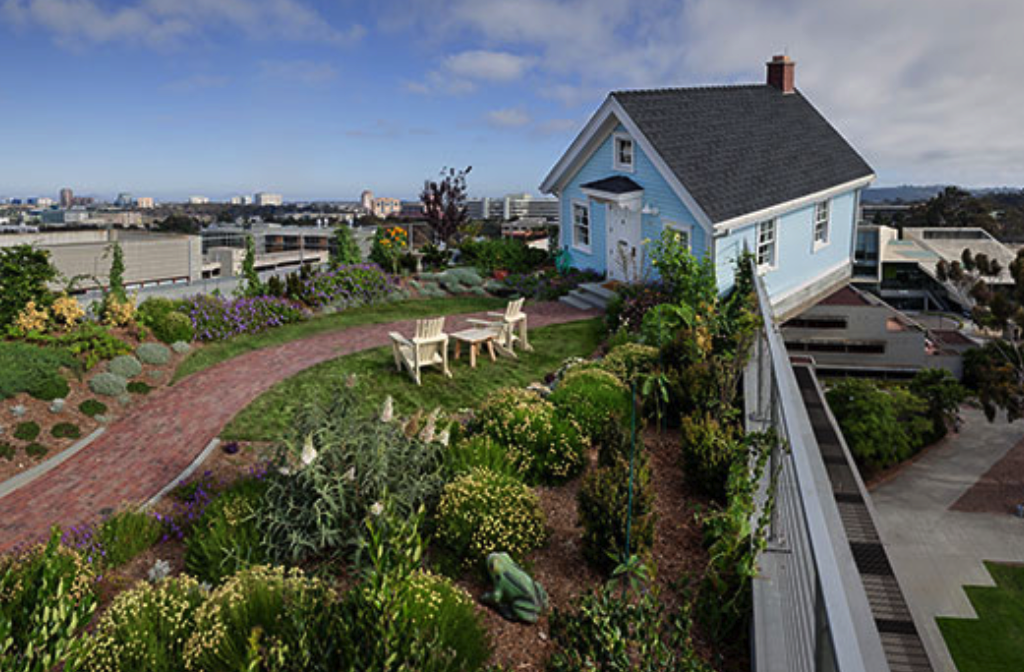
Yes, it’s a house embedded into the corner of a building. Indeed, it is attached to the Jacobs School of Engineering main building. “Fallen Star” is an art installation by South Korean artist Do Ho Suh. The house is fully furnished and has a “yard.” It’s open a couple of days a week for public tours. Here’s a closer view from the UCSD “Fallen Star” website.

Back to more “mundane” matters.

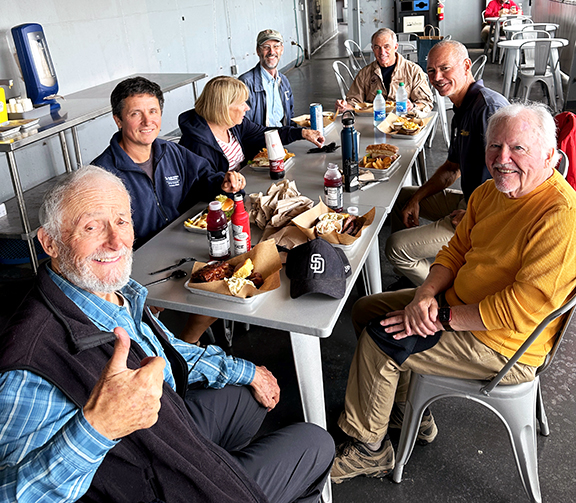
Dinner at Harlow’s. Alice, Winter, Meredith, and Adeline Anderson, Dillon and me.

The Kenahs joined us, including the Andersons and Dillon, for dinner at Harlow’s, a new restaurant in neighboring Bonsall. They spent that night and the next just up the hill from my house in a neighbor’s unit rented through Airbnb. Short walk between us.

Tuesday was our day in the desert. I had taken Larry out to Anza-Borrego Desert State Park during his visit in 2013 for the BC-USC football game in LA. Though Marcy had originally planned to accompany Larry here then, she decided assisting with a new grandchild was more deserving. She was particularly interested in making the trip to the desert on this visit.

Joining us on the trip were Betty and Wayne White, long-time friends of the Kenahs who live in San Juan Capistrano. As the route they planned to take to the desert brought them only two miles south of my house, we connected with them in Bonsall and caravanned out to Borrego Springs.

First, however, was a stop at Warner Springs to see Eagle Rock. It is a natural rock formation, located on the Pacific Crest Trail, but accessible only via hiking, three+ miles each way from Warner Springs. You can see it, however, ironically to Eagle/BC fans, from Camino San Ignacio. I had hoped we could get through the fence and get closer on foot, but the Vista Irrigation District, which owns the land, seems to have bolstered their barbed wire defenses. From the road, it was somewhat more difficult to discern the shape.

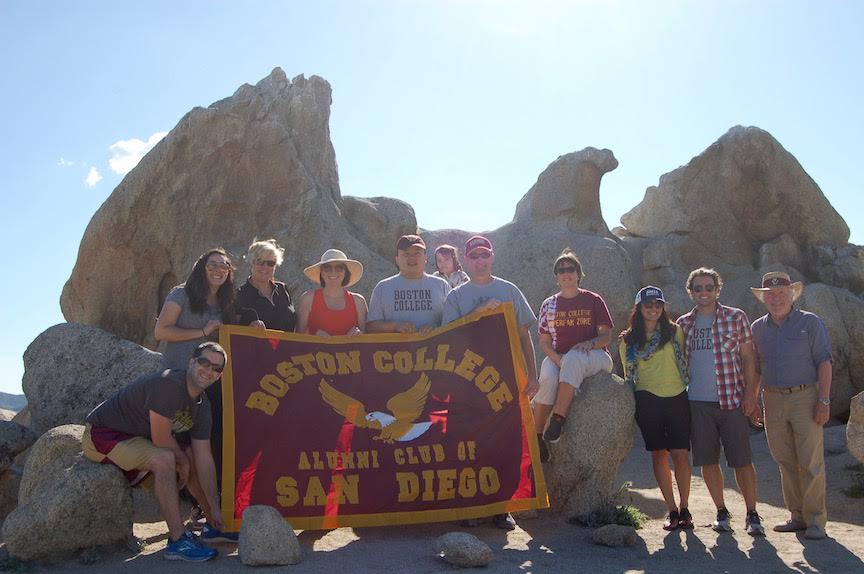
This photo had been taken on an alumni chapter trip to the rock in 2016. 

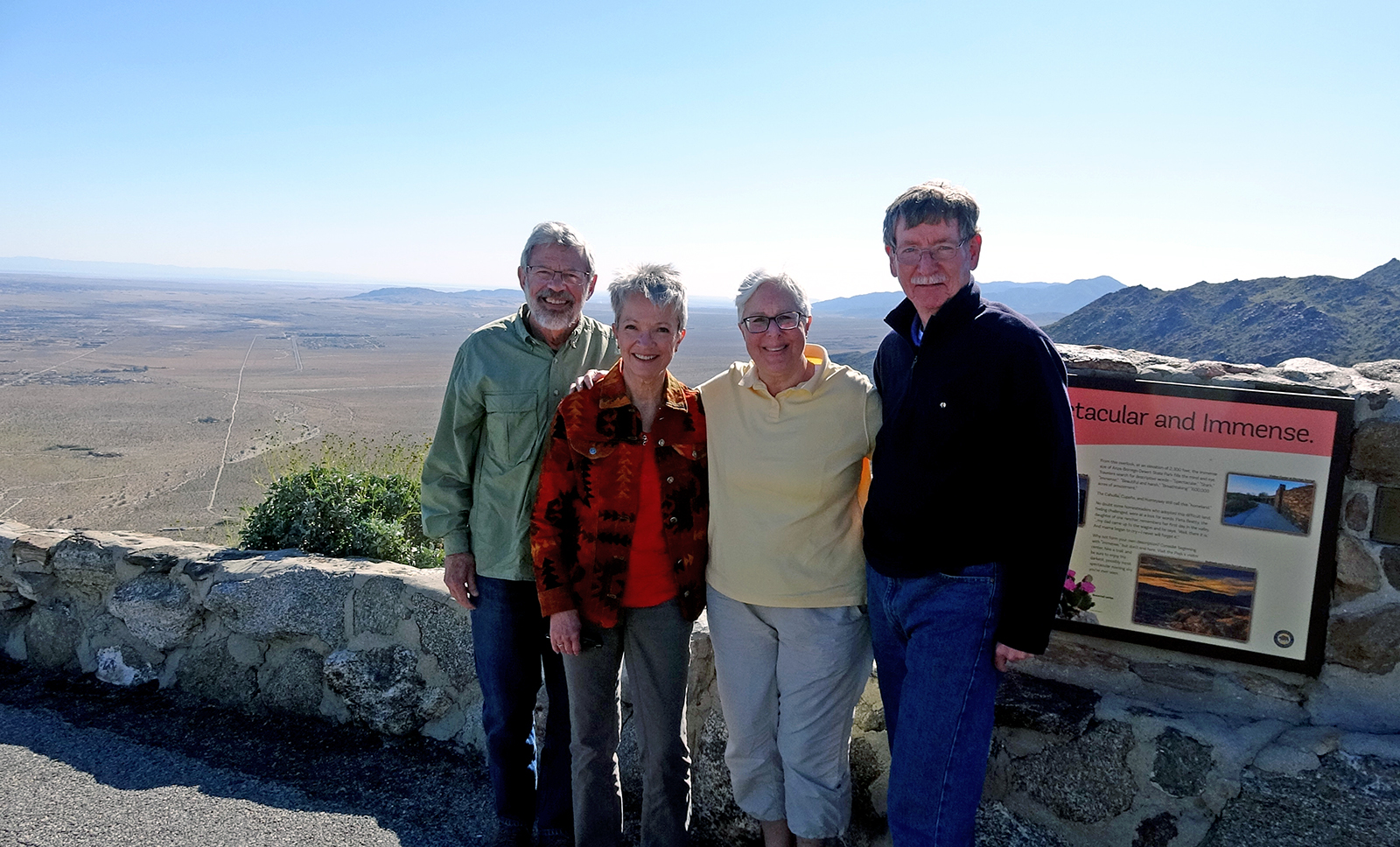
After Warner Springs, we drove down the dramatic Montezuma Grade from Ranchita to Borrego Springs. It’s a drop from 4,065 feet in elevation to 597 feet in 10 miles of severe switchback roads. Here’s a shot of the Kenahs and Whites at an observation point on the grade.

(L-R) Wayne, Betty, Marcy, Larry

We took a brief tour of the community of Borrego Springs, visiting the Anza-Borrego Foundation offices and its State Parks Store, both at The Mall. Then we made a stop at the Serpent Sculpture and drove east to the Badlands. Returning to Borrego Springs for lunch, we then drove out to the Texas Dip and visited Tamarisk Grove, finishing with hikes on the Cactus Loop Trail and Yaqui Well Trail. Here’s video (2:59) of the day in the desert.

Marcy in “the chair” at Stone Bistro.

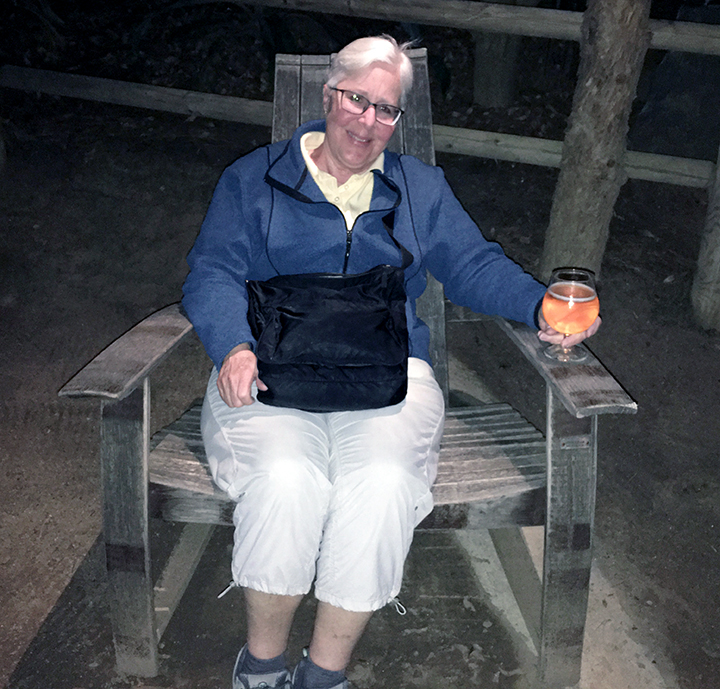
We then headed west to Julian, climbing back up to over 4,20o feet elevation, to make a stop at the Julian Pie Co., for some of their delicious apple pie. The Whites then headed off to the rest of their day and we made our way to the Stone Brewing World Bistro and Gardens in Escondido for a repast. When Larry visited in 2013, we concluded my San-Diego-County-in-a-Day tour there and he sat in one of Stone’s Adirondack chairs holding a cold beer. Since that visit, I have brought each visitor there to have them sit in the “Larry Kenah Commemorative Chair.” It was near dark when we got there this year so the picture of Marcy in “the chair” is less than excellent.

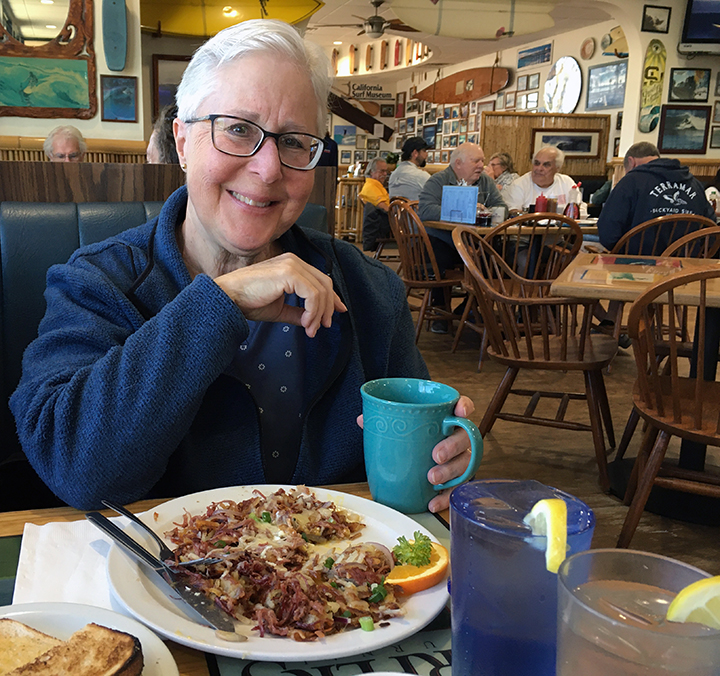
On their last day with me, we started at my favorite breakfast spot — Beach Break Cafe in Oceanside. I have never eaten any thing there other than corned beef hash. Larry and Marcy were sufficiently persuaded by my enthusiasm to order it as well and are now, I believe, fellow enthusiasts.

Oceanside, once a pretty tawdry town infused with off-duty Marines from adjacent Camp Pendleton, has improved by at least several notches. It is still a quintessential SoCal beach town. Beach Break is in “South Oceanside.”

Outside Beach Break, on the Pacific Coast Highway.

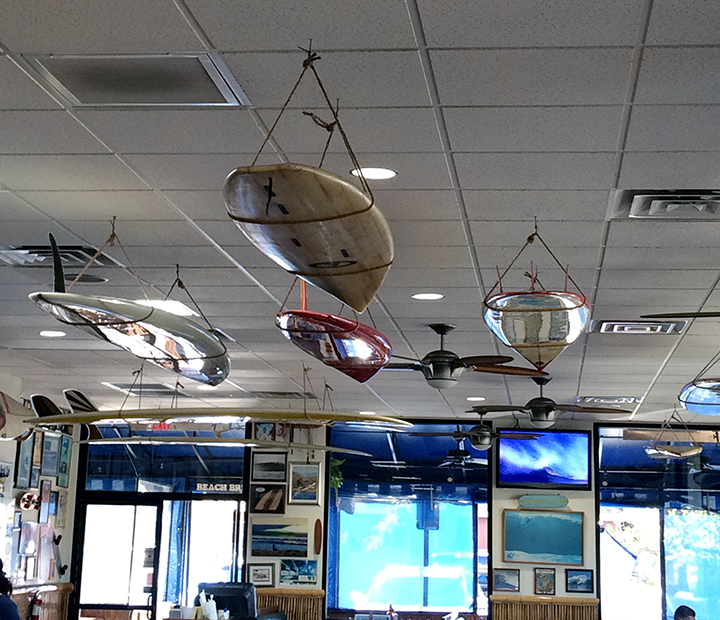
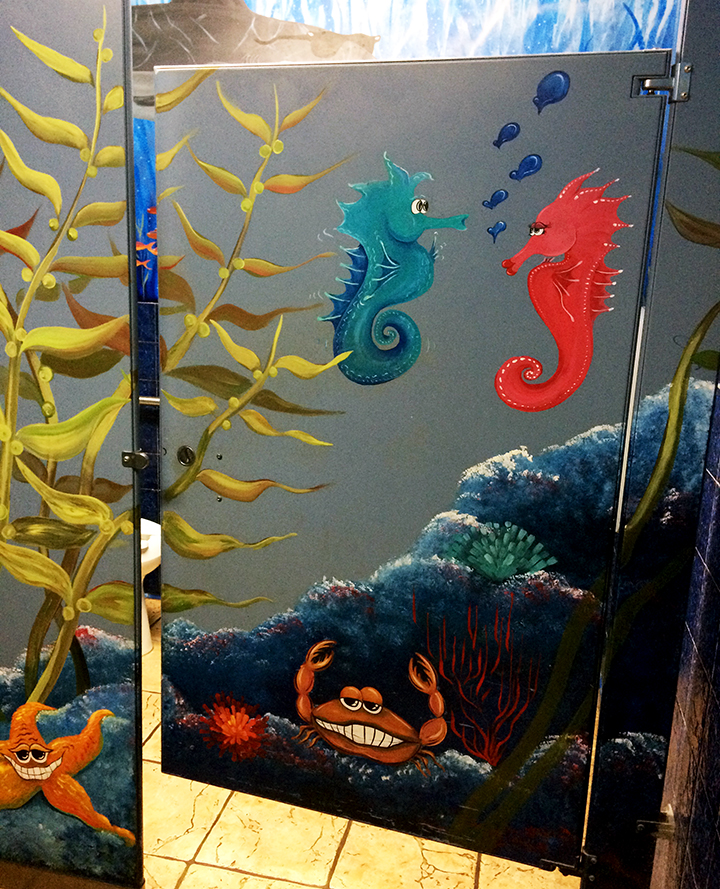
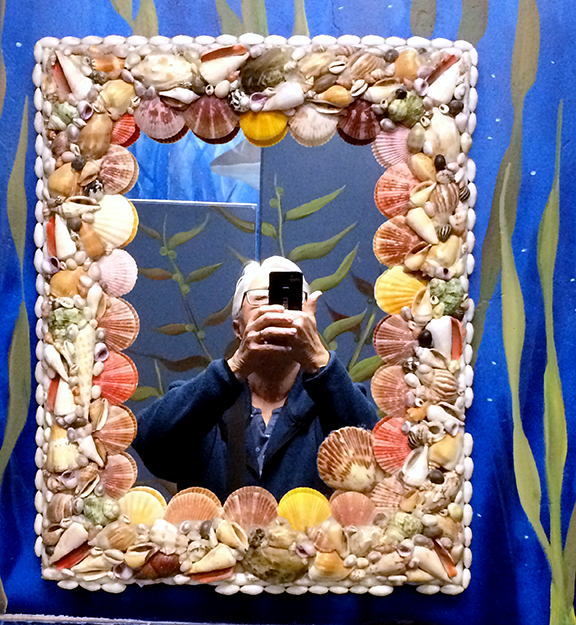
Beach Break does not hold back on its surfer vibe. Surfboards hang from the ceiling and are mounted on walls. Video screens show great surfing rides. The walls are festooned with photos, many autographed by the famous surfers who have visited the restaurant. The oceanic vibe extends to the restrooms as well. Here’s a gallery of shots taken at the restaurant by Marcy.


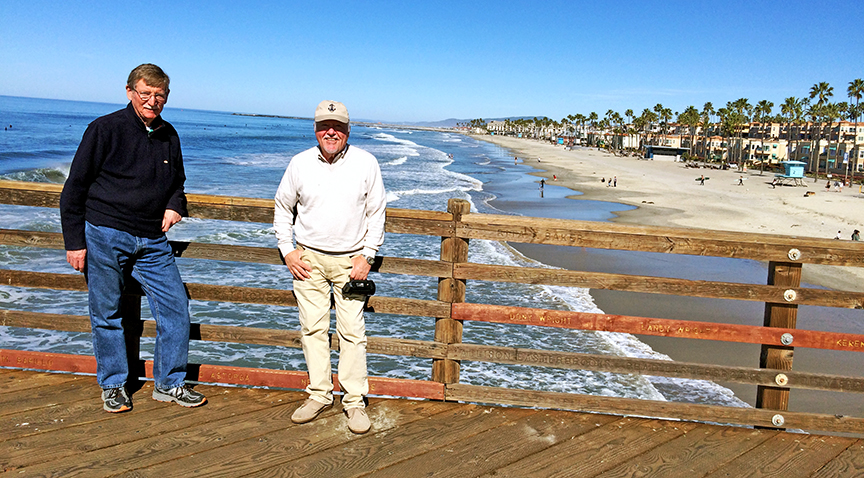
We then took the short trip to the Oceanside Pier. At 1,942 feet, it is reportedly the West Coast’s longest public pier. We walked maybe halfway along the pier, watching the waves, surfers, and birds. Here’s Larry and me pier side north.

Here’s very brief video (0:24) from the pier.

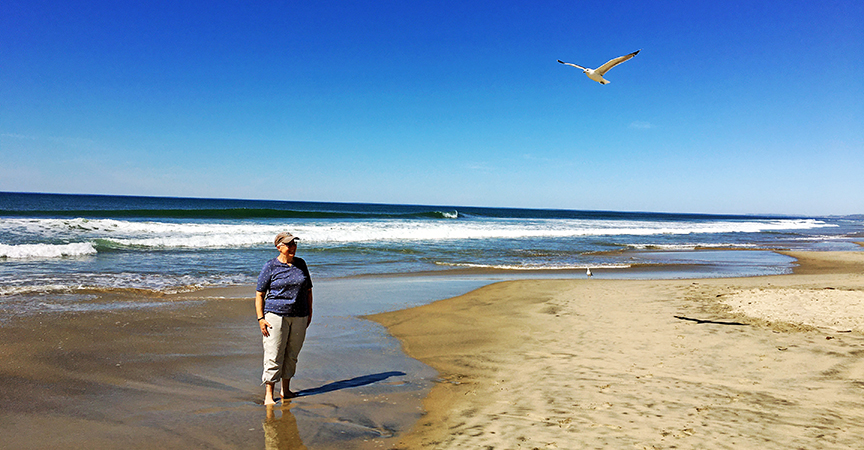
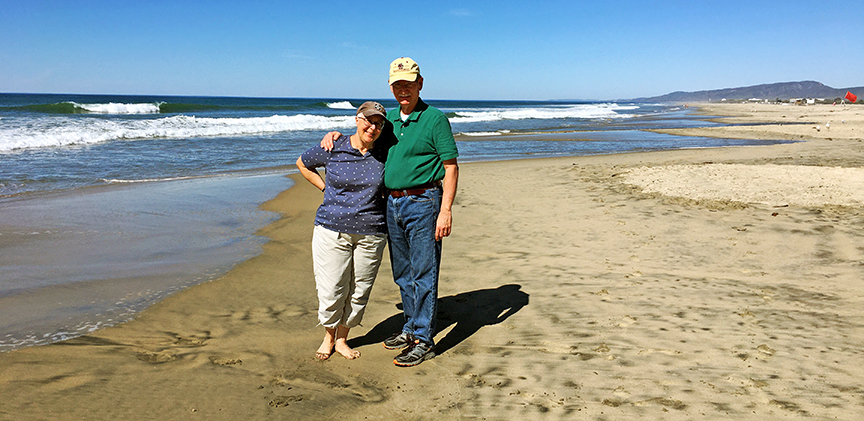
Just a short hop to Del Mar Beach (not the town) at Camp Pendleton.

It’s about a dozen miles from the coast to Fallbrook and the route is essentially across the width of Camp Pendleton and the adjacent Naval Weapons Station, where taking photos is problematic.

After lunch in “downtown” Fallbrook, the Kenahs took off for the Whites’ home in San Juan Capistrano to finish their SoCal week. As I consistently and perhaps annoyingly reminded them during their visit, “It’s February!”


A Rose is a winner

The Farmers Insurance Open this year at Torrey Pines Golf Course, La Jolla, featured its best field (19 of the top 30 in FedEx standings), the 2019 debut of Tiger Woods on the tour, and what one TV commentator called “spectacular weather.” I concur. Best weather throughout the tournament in the seven years I’ve been a marshal.

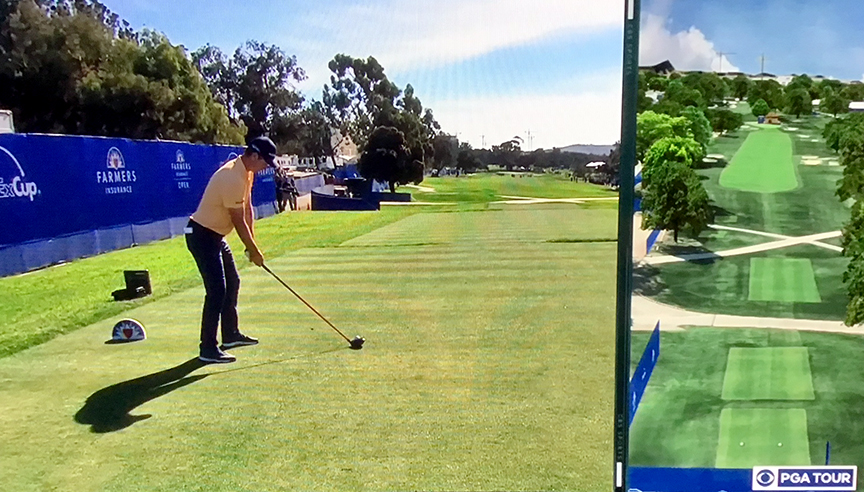
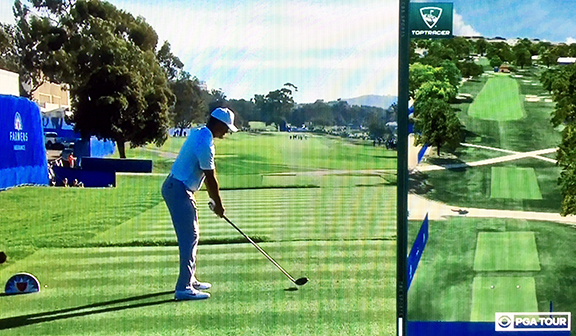
Leader and eventual winner Justin Rose on the tee of 9 South, with a schematic of the hole at right.

This year’s tournament didn’t have the excitement of the extended playoff last year. World #1 Justin Rose took the lead in the second round and came to the final hole with a two-shot advantage over Adam Scott. Each birdied the hole, so Rose won by two. His total of 267, 21 under par, was a tournament record. Rains the previous week made the rough very thick, but also made the greens somewhat soft and better able to hold an approach shot.

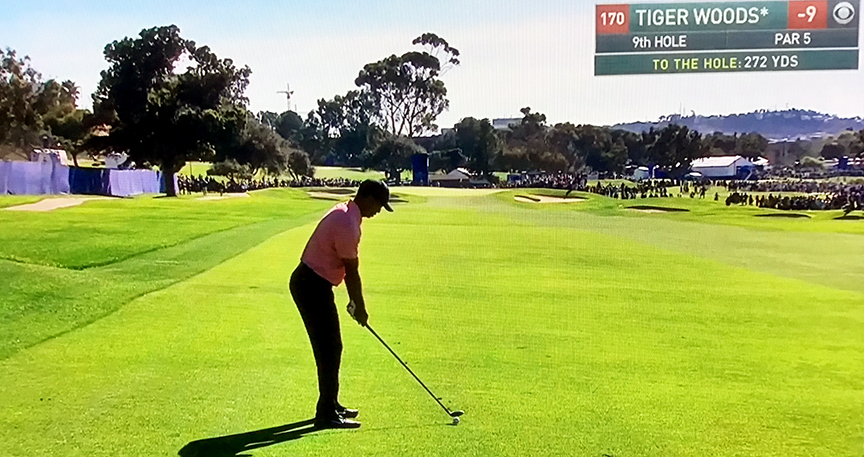
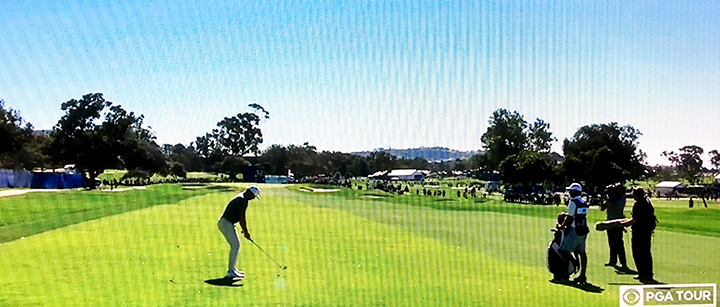
Tiger on the fairway, 9 South

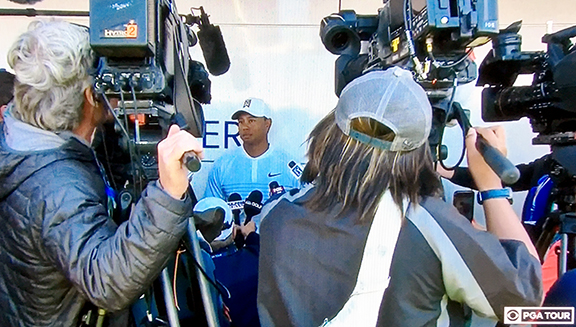
Tiger was back at Torrey, where he has won various tournaments nine times, for a second year following an absence of a few years. Crowds following him were the largest Thursday-Saturday and, if smaller than that with the leaders on Sunday, not by much. He saved his best for the final round, shooting five birdies for a score of 67. Overall, he finished 11 shots behind Rose, tied for 20th.

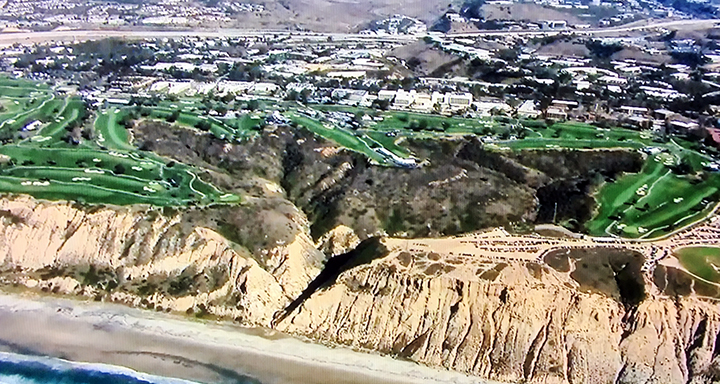
Screenshot from a video broadcast by CBS showing a surfer, with La Jolla in the background.

With high temperatures around 70 and bright sunshine throughout, the telecast of the tournament was also an advertisement for San Diego. In addition to the visuals provided by the Goodyear Blimp, CBS added video snippets of local scenes and announcer Jim Nantz piled on with praise for the region. On the first of my three seemingly interminable drives back from La Jolla to Fallbrook during rush hour (Wednesday), Nantz was interviewed on a local sports talk show and he basically said then that he was going to talk a lot about how much he liked San Diego.

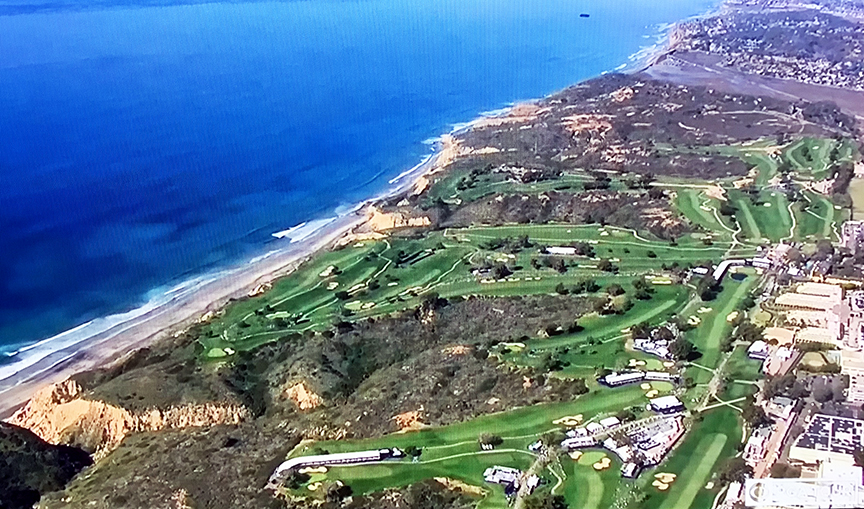
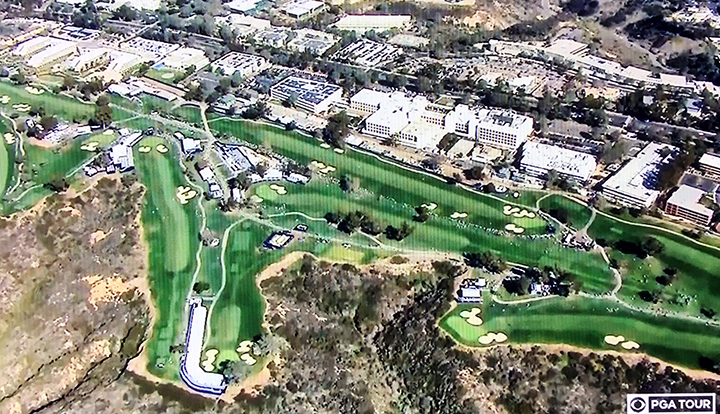
Aerial view of the North Course, top, and some of South, below. Nine South is at lower right.

Wednesday is the pro-am tournament and it is essentially the toughest single day of the year for me. This year, I was there from pre-dawn to post-sunset and, to do that from 40 miles away on a weekday, meant I left at 4:45 am and got home after 7 pm. At the course, I met the 14 marshals, both returning and new, assigned to 9 South, and assigned them positions for the day.

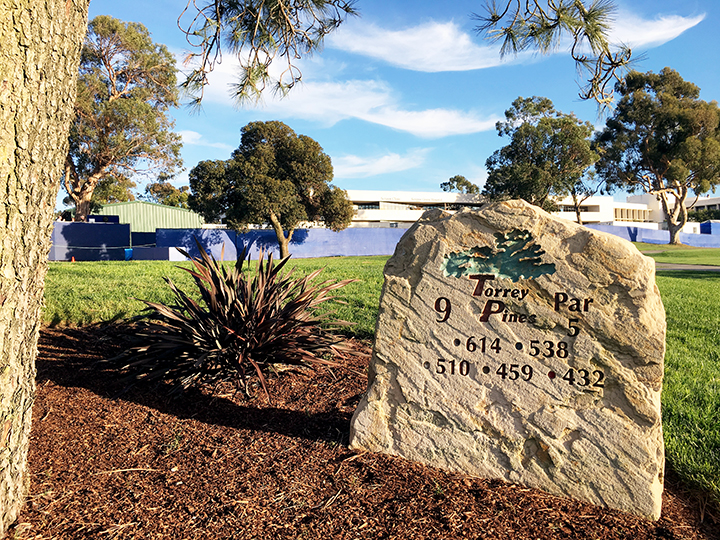
Nine South, which plays 608-615 yards depending on where they place the tee markers, is a gentle monster. For professional golfers, especially, it’s a gentle par five. In terms of average score, players hit under par and on that basis it’s one of the easiest holes on the course. For a hole captain walking up and down the 600 yards, checking in with marshals assigned to the elevated tee area, the first landing area, second landing area, and the green, it’s a monster.

According to the Health app on my iPhone, I walked 6.7 miles, taking 17,258 steps and climbing 15 floors, last Wednesday. The mileage total meant I had walked the equivalence of the length of the hole about 20 times. Over the other four days, I spent less time moving about. It was better for me to assist at the first landing area, where maybe two dozen golfers hit drives over a fence into a concession area. When that happened, we had to move people away from the ball or the point at which it had crossed over the fence to permit the golfer to hit, usually after a free drop.

My walking distances for Thursday-Sunday were between 2.8 and 3.4 miles. Totals for the five days were 19.4 miles walked, taking 49,767 steps and climbing 46 floors. I also estimate that of the approximately 40 hours I spent on the course over the five days, I stood or walked for perhaps a total of 39 of them. Times to sit were very brief. When I got home each night, I was tired.

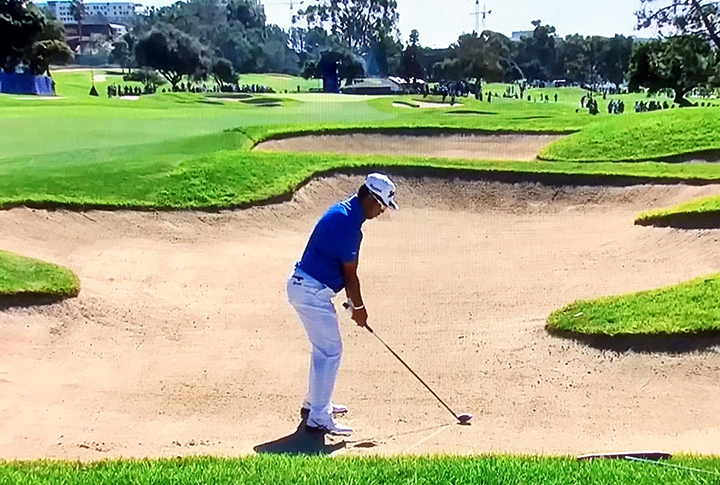
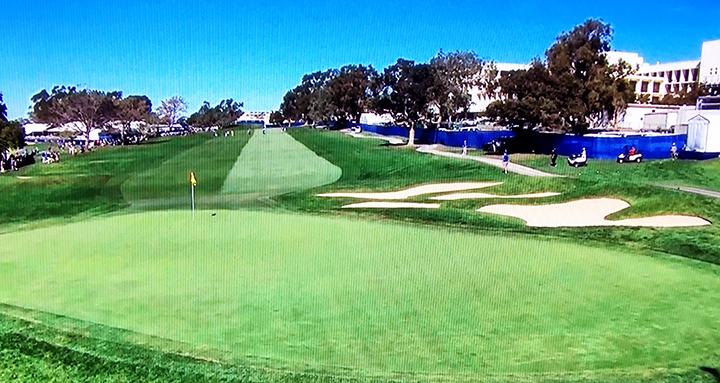
On the final round, 9 South featured what some called the shot of the day. Hideki Matsuyama hit his drive into a sand trap on the right. His ball was about 280 yards short of the green. As he lined up to hit, TV commentator Sir Nick Faldo advised viewers, “Don’t try this at home!”

Matsuyama’s three-wood shot out of the sand landed on the green, less than 20 feet from the hole. He missed the eagle putt, but made his birdie easily.

All the images here were captured off telecasts. While spectators can take photos with phones, not cameras, during the tournament, marshals cannot, or at least are not supposed to.

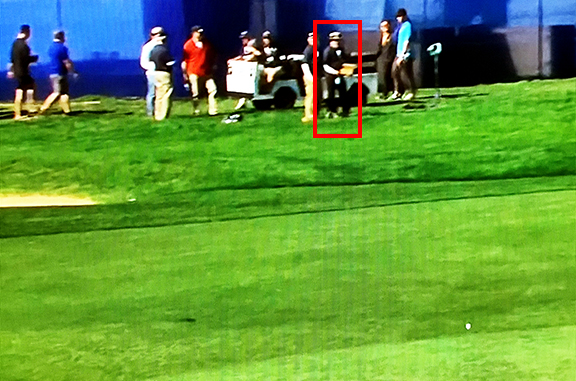
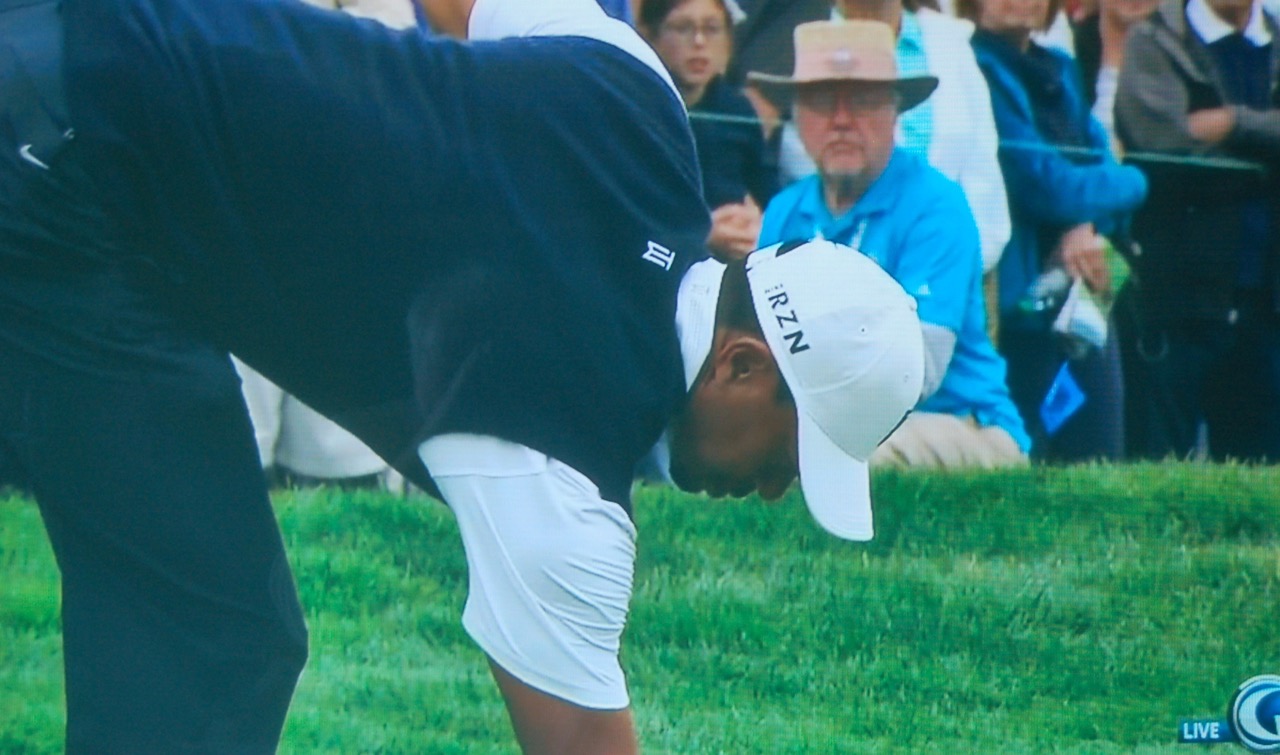
I had recorded the telecasts of the tournament and went through them Monday and Tuesday to see if any of my marshals could be seen. There were a few, so I took screenshots and sent copies to them. I also looked for myself. And the picture here was the closest I found. (My uniform is predetermined: black pants, provided polo, wide-brim hat, white [only white] lower sleeves.) Last year was even worse, as I only appeared in a shot from the blimp. Only I would have known I was in it, just like this year. Nothing since has quite matched what happened in my second tournament (2014), which you can see below.


Tiger loose

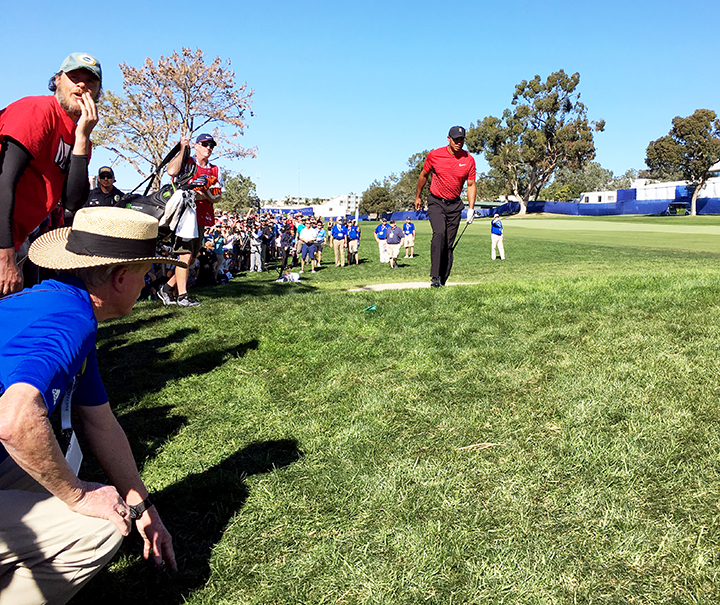
Following his second shot, Tiger Woods moves toward the green on 9S in the final round.

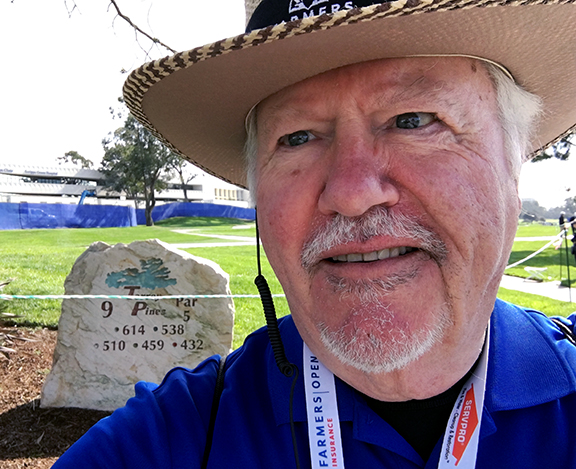
Once again, I spent five days in late January at Torrey Pines Golf Course working as a “hole captain” during the Farmers Insurance Open. It was my 6th year as a volunteer marshal, 3rd year as a hole captain, and 1st year on the 9th hole on the South Course (9S).

As a hole captain in 2016 and 2017, I had been assigned to a 214-yard par-3 hole on the north course and oversaw a crew of 4 marshals. At 614 yards, 9S is 400 yards longer and “my crew” consisted of 19 marshals, swelling to 27 on the weekend, as we were joined by marshals who had worked North #9. (Both courses are used in the pro-am and before the cut, with the final two rounds taking place only on the South Course.)

This year, as you might infer, was harder. It was more difficult physically and more complicated logistically. The job of a hole captain is to help make the experience of each marshal as pleasant and satisfying as possible. You make sure they get lunch, that they have bathroom breaks, that they get to do different jobs on the hole, etc. You also train them, give advice, answer questions. Seven of my 19 marshals were rookies, their first time as a marshal.

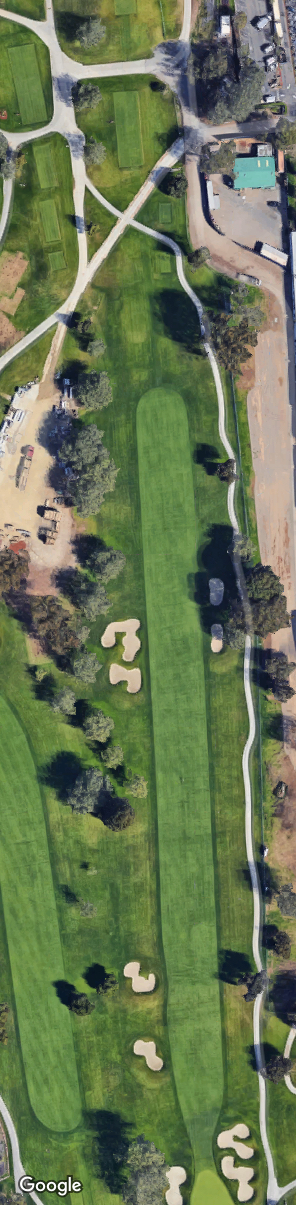
Google satellite view of 9S

The physical aspect of 9S that is challenging for a hole captain, as well as for any golfer on the hole, is its length. As a golf challenge, it is not difficult for any reason other than distance. As hole captain, I walked around to each marshal’s post all day. The app on my iPhone reported that on Wednesday, the first day and the pro-am, I took 16,091 steps, covering 6.4 miles, and climbed the equivalent of 15 floors. Numbers were lower in subsequent days, but, in total for the 5 days, I took 56,072 steps, covered 21.8 miles, and climbed 42 floors.

When I wasn’t walking, I was standing. I would estimate that, over the course of the 5 days at the hole, 8-10 hours each day, I sat for a total of less than 30 minutes. This, I guess, is my annual workout.

As with other events at which one works, the focus is more on the immediate, “little” things than the overall event. Marshals seek to manage the fans, providing golfers with quiet and space to do their job well. We also aim to make the experience enjoyable for fans as well, usually by trying to manage those fans who are loud and obnoxious.

The big difference this year was, surprise, Tiger. For marshals, it was not due to his golf, but because his return to golf and to this tournament attracted people. Crowds were not large overall on Thursday and Friday, though his crowd was much larger than anyone else’s. Even though he was not in contention on the weekend (he barely made the cut), the number of people following him was larger than that following Phil Michelson and the leaders’ threesomes combined.

A true fan

But it’s not just the number of people. There are many people who follow Tiger because they want to see him play golf. There are many other people who follow him because of his celebrity. Those people do not seem to care about the etiquette of golf, or much about etiquette at all.

I was not present at the time, but at #9 North on Friday, Tiger’s errant tee shot resulted in a situation that made the local news. His drive went into a section “outside the ropes” and amongst the crowd. Fans surrounded the ball and, despite the efforts of 7 marshals and 4 San Diego police officers, no one would move to permit Tiger to play his next shot. They only moved when Tiger’s caddy shouted out that Tiger would not continue play until everyone moved to the other side of a cart path.

On Saturday, he was to finish his round on our hole, having started on #10. As it would happen later in the day, it would mean maximum crowd. Adjacent to the area where most drives land on 9S, the space for people on the right side of the fairway was narrow, because of fencing around a corporate tent. If Tiger hit one outside the ropes there, we foresaw calamity. As his arrival at the hole approached, more than 20 marshals from holes that had finished regular duties, arrived at 9S to help. I basically just asked them to be a “command presence” alongside the ropes in the landing area. They would also add to the number of marshals and other personnel who could help control the crowd, if we had to move them.

Standing in the fairway awaiting Tiger’s drive, I watched the marshal whose job was to indicate the direction of the drive. His paddle was straight up, Tiger hit, and the paddle then moved up and down repeatedly, indicating straight. Drive landed in the fairway. Problem avoided.

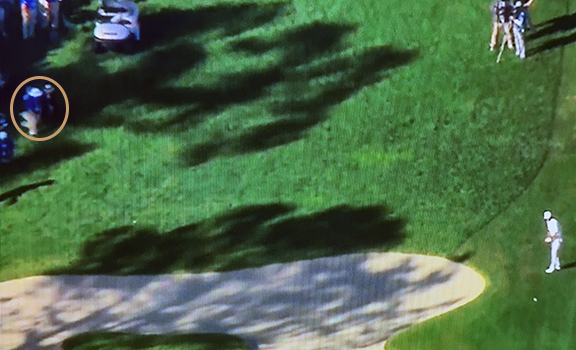
View of Tiger’s second shot on Saturday from blimp. My only appearance on TV. 🙁 I’m in circle at left, in hat with black band.

Sunday was the start of a heat wave, and it also featured Santa Ana winds, the hot, dry, strong winds from the interior. Because a couple of marshals were taken from my hole for other duties, I spent the day on the right side, at the landing area for drives (just about the same spot as in the photo above). Over the course of the day, 7 or 8 golfers’ drives were pushed by winds over the fence around the corporate tent. As marshals, we were to report the fact to the golfer as he arrived and secure a place where he could get a free drop and make his next shot. A PGA rules official would arrive and ask us to confirm the drive had gone over the fence and to indicate about where it had done so. Then we stopped people walking from either direction toward the spot and cleared an area for the shot.

The tournament ended in a tie between Jason Day and Alex Noren. They played five playoff holes Sunday, remaining tied, before darkness forced postponement. Focused on “my job” and really looking forward to getting home, I had left and was unaware of the situation until the next morning when I picked up the paper in my driveway. (Is that old-fashioned or what?) I watched the playoff on TV a little while later and saw Day win by two strokes on the first hole.

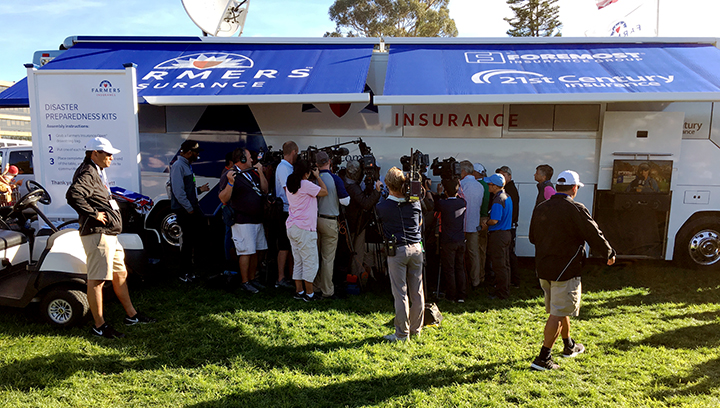
This year’s experience was distinctive. More difficult, more intense. In some respects, more interesting. I won’t be a rookie on this hole next year, so I look forward to it all again. Here’s a gallery of images, a mix of screenshots from television and my photos.