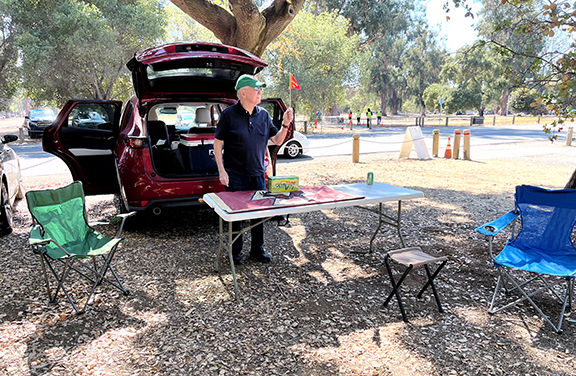
As my car was to carry the “stuff” for the tailgate Saturday afternoon, there was room for only one passenger and Tom Sugrue volunteered to help set up the table, chairs, etc.
We arrived at the entrance to the preferred tailgate area at 2 pm, 30 minutes before it was to open. We were the first car in line. And soon after the gate opened, we were ready.
Tom at the tailgate, ready for more!
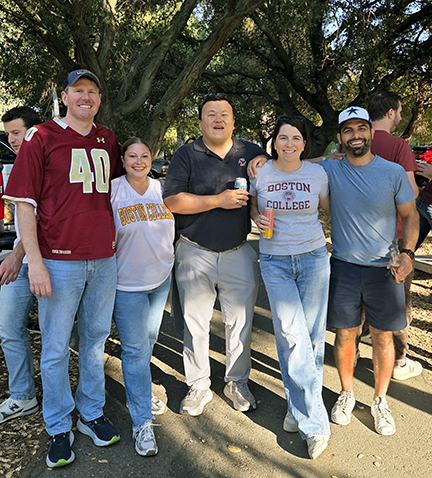
The rest of the Moss Beach group was to arrive via Uber a bit later in the afternoon. Meanwhile, we were soon joined by Lissa and Brian Tsu from the San Diego alumni chapter, Chris Lamb from the Bay Area, and an increasing number of BC alumni.
L-R: Bill Connors ’00, Alyssa Connors, Brian Tsu ’00, Lissa Tsu ’00, and Diego Garcia.
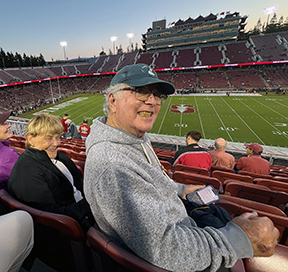
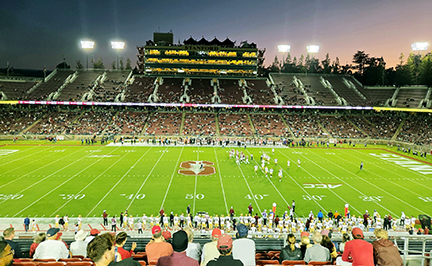
Too soon, it seemed, it was time to go to the game. As mentioned in the first post, our seats were pretty good. Here’s the view.
The performance by the Eagles didn’t match the quality of our seats. Tied at halftime, BC didn’t score again and allowed Stanford 10 second half points to give the Cardinal their first win of the year, 30-20.
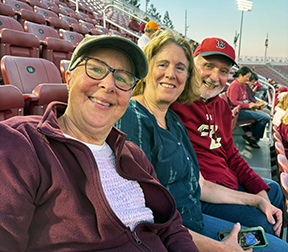
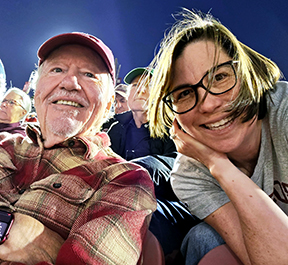
Here are some snapshots in the stands.
Marcy, Jackie, and EdShelia and DanLissa and me, and Tom Sugrue right behind us.
A great day. A disappointing evening.
The drive home
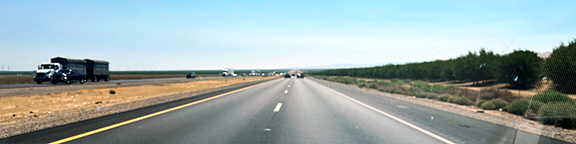
Heading south on the 5. Still straight.
The trip back to Fallbrook took two hours less than the drive north. Two basic reasons: it was a Sunday and, when I got to the LA area, I took the inland freeways instead of the coastal ones.
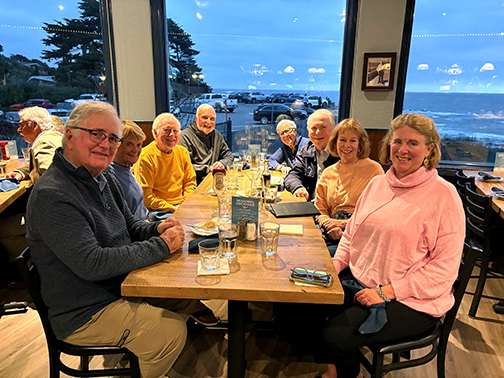
Friday night before the BC-Stanford game, the crew that stayed in Moss Beach went out to dinner at local favorite, the Moss Beach Distillery Restaurant.
L-R: Dan Downey. Shelia Downey, Me, Ed Hattauer, Marcy Kenah, Tom Sugrue, Pat Sugrue, and Jackie Hewitt.
Meanwhile, in Menlo Park.
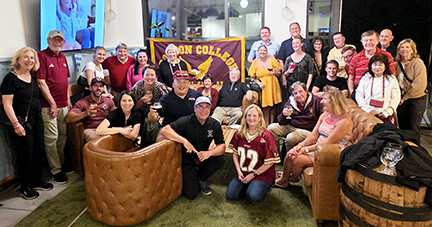
Members of the San Diego chapter, as well as some from LA, Orange County, and San Francisco, gathered Friday evening in Menlo Park for pre-gaming.
The 7:30 pm kickoff time for the game meant that tailgating could start after 2:30 pm on game day. So that left some time Saturday morning for a walk around the local area, particularly the seashore.
Most of the others had gone earlier, so I was on my own. The Fitzgerald Marine Reserve is a San Mateo County protected area. The coast there is primarily an inter-tidal area, where the difference between low and high tide creates a distinctive environment for algae, crabs, sponges, seastars, mollusks, and fish.
Throughout our time in Moss Beach, we would see flocks of birds, mostly brown pelicans, flying north and south along the coast line. Soon after entering the marine reserve and standing on a bluff, I was lucky enough to view such a flock flying north below me.
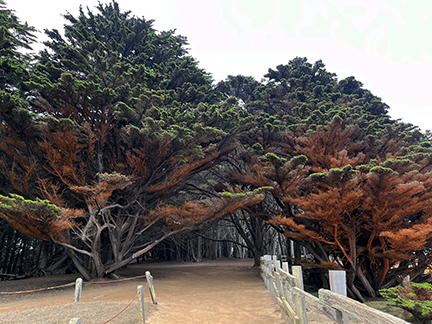
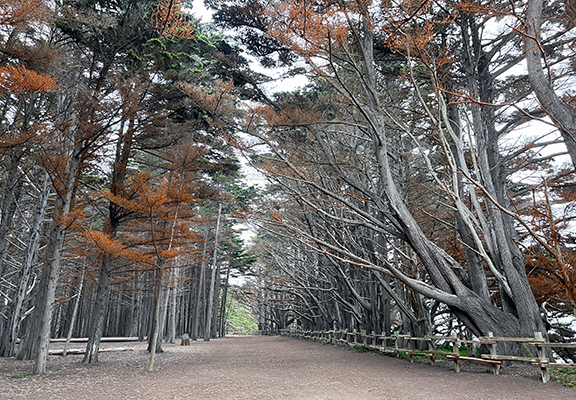
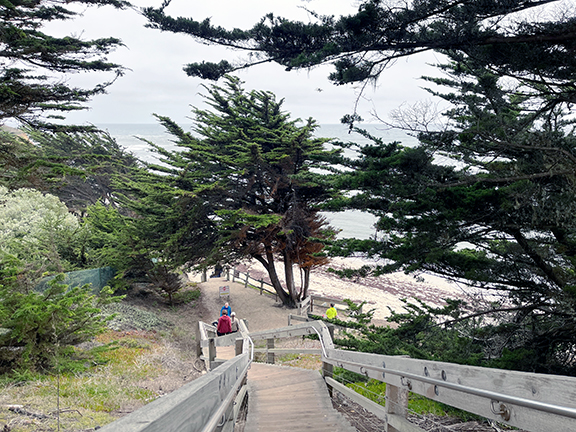
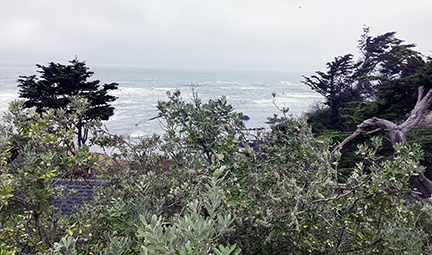
Plant life, most notably trees, was also distinctive in this environment. The local unofficial name for the area is the “enchanted forest.” Here are some views.
And the stairway to Seal Cove Beach. Didn’t take it.
I had been to Stanford Stadium twice before, but both times were in the 20th century. Went to a Big Game (Cal-Stanford) and to an exhibition game there between the then-Oakland Raiders and New England Patriots. Son Dillon, big Pats fan, joined me for the latter game.
I had not experienced the Stanford campus, however. Had seen lots of pictures of the buildings and knew the campus was huge, but I wanted to spend time there walking around and also to scope out the locations near the stadium where we wanted to have our tailgate.
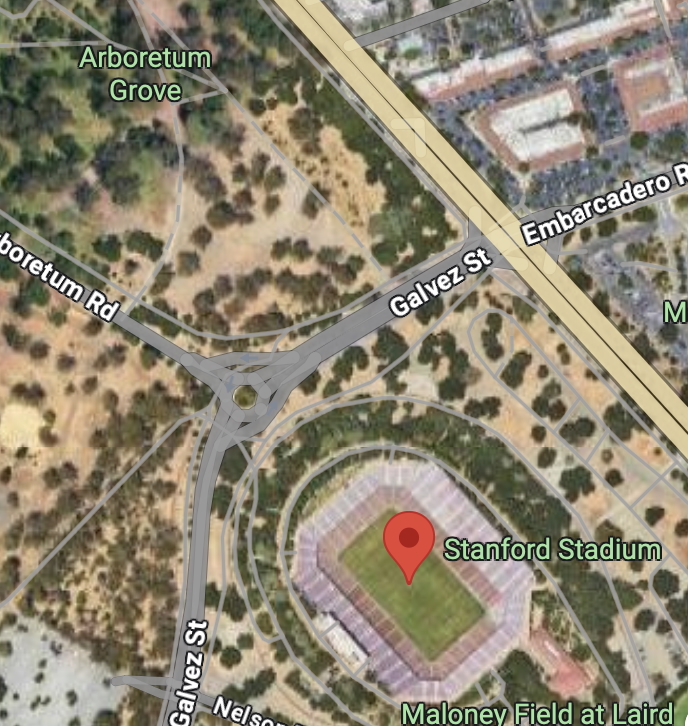
I went to the campus, about a 45-minute drive from Moss Beach, Friday morning and parked at the Visitor Center, where I picked up a map. My first walk was to the stadium and, more importantly, the Arboretum adjacent to it. I had purchased a parking pass in that location.
Instead of paved parking lots, the stadium is surrounded by groves of trees. Tailgaters park among the trees, which provide shade. It’s just a much more pleasant environment for a tailgate than an open field or parking lot.
After getting some eyes-on orientation to the tailgating location, I headed to the academic area of the campus. I took just under 11,000 steps that day, which an online calculator gauged to be just under five miles.
Stanford did not begin its “autumn quarter” until more than a week after the BC game, so the students on campus were primarily grad students. And while the campus is open to automobile traffic quite extensively, based on the number of bicycles I saw being ridden or in racks, it’s a bike-centric campus.
Official University logo
The Stanford logo is a cardinal red “S” with a green sequoia tree superimposed on it. After walking around that campus, I get it. Trees are plentiful and are somewhat honored with arboretums and identified “groves.” (The “Stanford tree” that you see with the Stanford student band is the mascot of that band, long recognized for boisterous and, in the opinions of quite a few, offensive behavior. The University has no official mascot.)
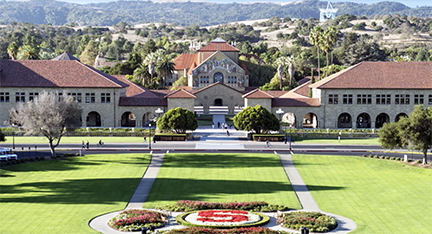
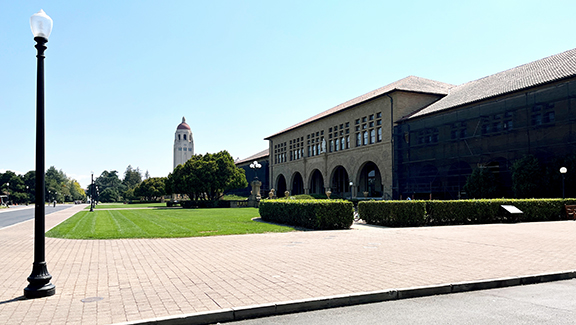
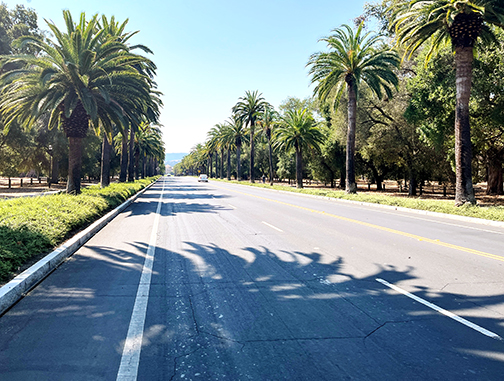
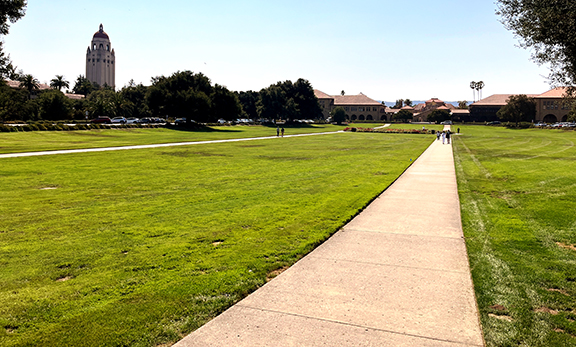
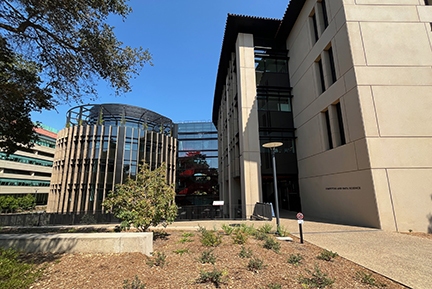
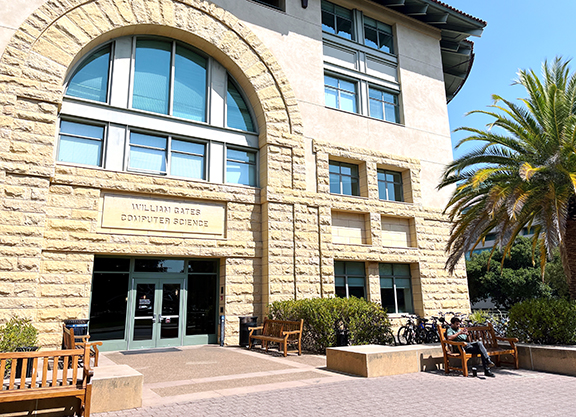
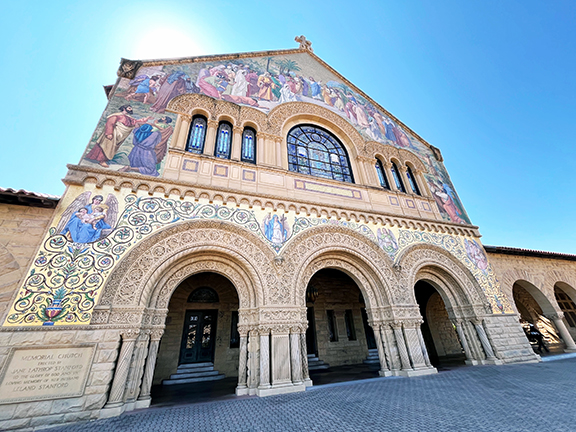
Below is a gallery of scenes from my walkabout. Clicking on any of the thumbnails will present larger image.
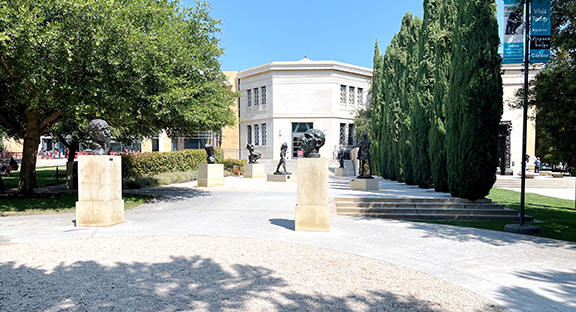
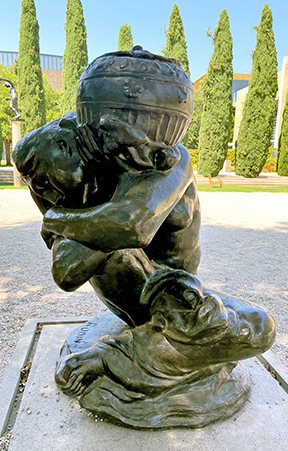
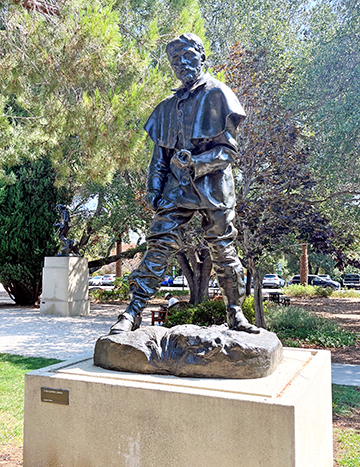
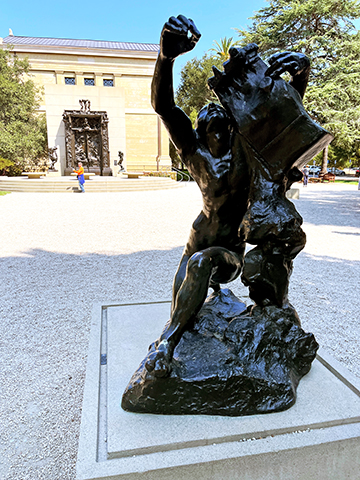
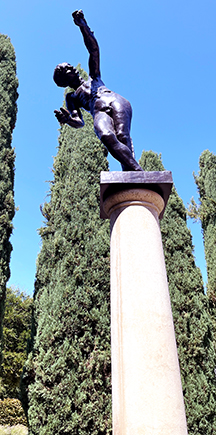
A specific target of the walkabout was the Rodin Sculpture Garden, with 20 of the noted sculptor’s most famous sculptures on display among cypress trees and gravel paths on an acre of land.
Entrance to the Rodin Sculpture Garden
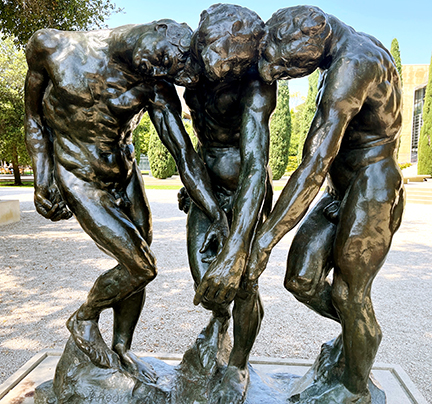
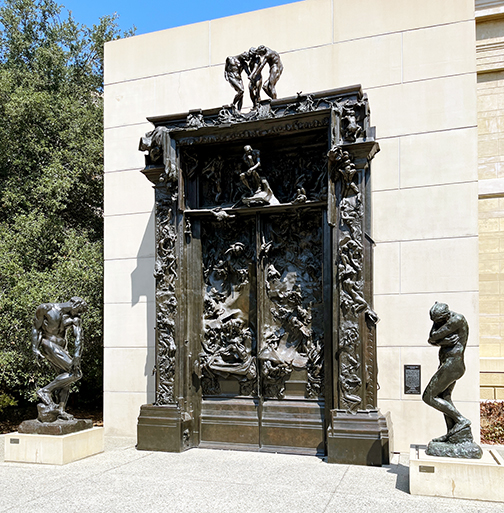
Here’s a slideshow of some of the sculptures in the garden.
I wore a somewhat bold BOSTON COLLEGE shirt on my tour and ran into several fellow alumni doing the same walkabout as I was. At one point, I came upon an older gentleman who asked me to take a picture of him and his daughter, which I did happily. He told me she was on campus to begin her doctoral program at Stanford. She was aware that BC and Stanford were to play the next day and wished us luck.
I had decided that I would drive up to Stanford for the long weekend. It would enable me to bring some of the “infrastructure” for the tailgate, e.g., a folding table, couple of camp chairs, and a large cooler for food and drink.
I had made the drive to SoCal from the Bay Area and back several times when we lived in the East Bay a few decades ago. Most recently prior to this drive north, I had done it in 2017, picking up my daughter, son-in-law, and two little granddaughters at SFO and spending a few days showing them where their mother had lived, gone to school, etc.
I left at 7 am Thursday, two days before the game, figuring most of that day would be on the road. The drive was going to be just under 500 miles and GPS said it was going to take about eight hours. I also planned to stop twice at Costco, one just north of LA and the other in Gilroy, for restroom and fuel stops.
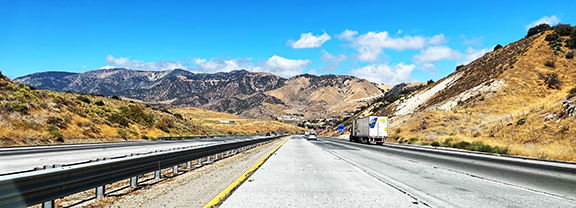
GPS also advised me to take the 5 (Interstate 5 to non-Californians) through LA. I knew most of the trip was going to be on the 5, the main north-south highway through California’s Central Valley. Was a little surprised GPS advised getting on it south of LA.
It wasn’t until I was stuck in morning bumper-to-bumper commute traffic that GPS finally advised an alternate route. It took me off the freeway into some of the least attractive areas of LA and then up onto the 210 to the east of LA through Pasadena.
There I was able to see some of the burn scars resulting from the fires back in January, as shown here.
Burn scars at upper left near Altadena.
The first stop at Costco was 90 miles from my house. It took me three hours to get there.
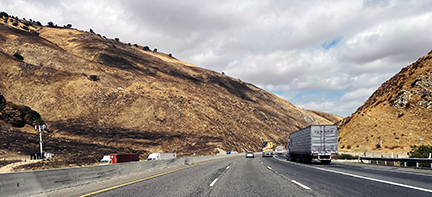
Going through “the Grapevine” north of LA on the 5 always seems interesting. Grapevine is not a formal name. There are various local references to grapes and grapevines, but it is where the 5 stretches from Santa Clarita, just north of LA, to California’s Central Valley.
The freeway goes through the Tehachapi Mountains, reaching an elevation of 4,144 feet at the Tejon Pass.
The Grapevine. Again, burn scars ahead on the left.
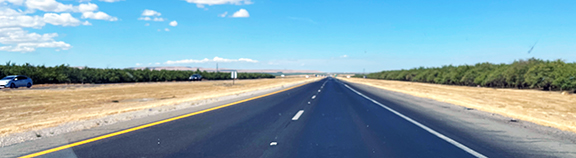
Once through the Grapevine, the Central Valley stretches ahead to the horizon and the 5 is flat and straight.
The straight 5.
For more than 100 miles, the only change in direction of any note is changing lanes on occasion.
On my second stop at Costco, in Gilroy, I picked up some of the local produce from the “Garlic Capital of the World.” Just garlic bulbs, not the garlic ice cream.
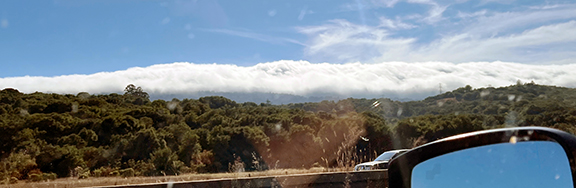
The weather forecast for Moss Beach and Half Moon Bay had changed significantly just days before. Instead of clear skies and high temperatures in the low 70s, the forecast was for the marine layer to persist throughout and for high temperatures in the low 60s.
From the road just east of the bay, evidence of the marine layer’s “cat’s paws” was pretty strong.
The last of the group to arrive at our Airbnb around 5 pm, I enjoyed the view and the chance to rest.
When it was announced that Boston College would play new ACC member Stanford in football September 13 this year, San Diego Eagles were interested in the opportunity to see their football team play on the West Coast for the first time in 12 years.
To assist, I contacted the Stanford ticket office in the spring to inquire about group discount tickets through them. We decided to set aside 50 seats on the upper level of the visitor side of the stadium at midfield ($40) and another 50 in the adjacent section ($25). They went on sale May 1.
We shared information on the tickets with members of the San Diego chapter, as well as alumni chapter leaders in Orange County, LA, and San Francisco.
Long story short, later in mid-summer we expanded the number of tickets assigned to us at midfield and ultimately sold 120 there.
I had purchased 10 tickets and transferred them via the web to nine classmates and partners who planned to head west for the game, replacing the usual game at BC for which I would travel east to join them. That was a nice change for me.
Jujube’s final visitor experience in May was at the Birch Aquarium, part of the Scripps Institution of Oceanography at UC San Diego.
We were joined on this trip by her nieces, Addy and Alice.
One of the main attractions at the aquarium is the recently-completed Scripps Living Seas Gallery, which displays several of the ecosystems and sea life of the Pacific.
Here is a sampling from that exhibit. First, fish . . . and some Garden Eels, which look like worms in sand. (The videos in this post can also be viewed on YouTube. Just click on “YouTube” at lower right.)
Also, jellyfish.
A small ray provided viewers a lot of enjoyment doing something that seemed to give it some enjoyment as well. It spent several minutes repeatedly seeming to climb up the tank and then glide down. On the video below, you can also hear a young child urge it on.
The aquarium also offers an extensive selection of seahorses and seadragons. Here are some.
Jujube and the nieces spent a lot of time at “Blue Beach,” an activities space at the Aquarium. There, they used available materials to build small boats and test their seaworthiness in a flowing stream.
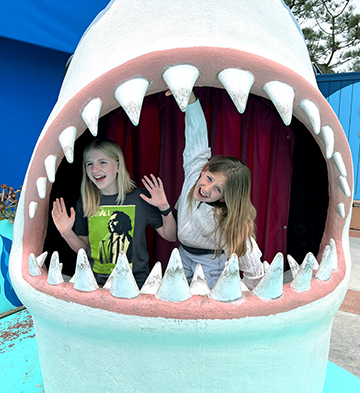
The nieces also fulfilled an Aquarium-visit requirement at Blue Beach by posing in the shark’s mouth.
Another distinctive exhibit at the Aquarium features Little Blue Penguins, native to New Zealand and southern Australia. They’re the smallest penguins, generally growing up to 10 inches tall and three pounds in weight. They don’t live in snow, but on coastal dunes and rocky shores.
I enjoy watching octopuses, but rarely see them in action. Often, they seem to be avoiding public view, up in a corner of their space. Not on this visit! Got to see one in action, moving across the tank.
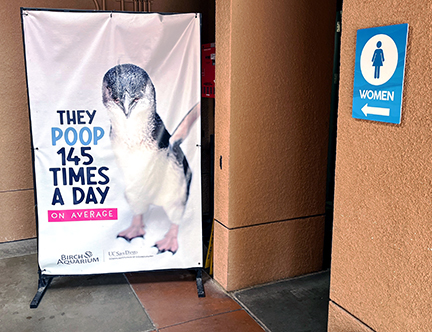
Finally, on the way out with a stop at the restrooms, noticed this sign. I assume “they” are penguins, not women.
 The performance by the Eagles didn’t match the quality of our seats. Tied at halftime, BC didn’t score again and allowed Stanford 10 second half points to give the Cardinal their first win of the year, 30-20.