 On Tuesday during Jujube’s visit in late May, she and I made a brief visit to the San Diego Zoo Safari Park in Escondido. They had added a Walkabout Australia section since she had last visited.
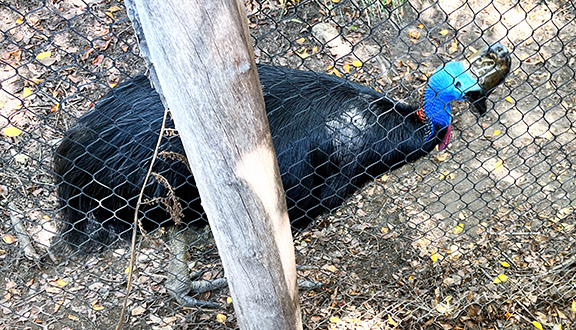
There we were able to see a cassowary (above), a large flightless bird most closely related to the emu. They’re native to Northern Australia, New Guinea, and nearby islands. Emus are taller than the cassowary, which is 4-5 feet tall, but the cassowary is the heaviest bird in Australia and second heaviest, to the ostrich, in the world.
Among the unusual features of the cassowary is its casque (helmet) atop its head. While distinctive, its purpose is uncertain. According to the Zoo’s website, the casque is “made of a sponge-like material and covered with a thick layer of keratin, the same thing our fingernails are made of. Although it is quite sturdy, the casque can be squeezed in the middle fairly easily.”
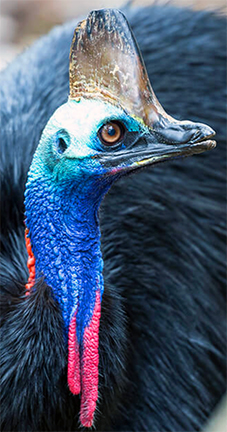 Two of the three cassowary species have “wattles,” fleshy pouches of skin hanging from the neck. They are colored blue, red, gold, purple, or white, depending on the species or subspecies. Again, the purpose is uncertain.
The cassowary is most active at dawn and dusk, so we were fortunate to view ours in motion and relatively nearby. To get a better view, the photo at left is from the Zoo website.
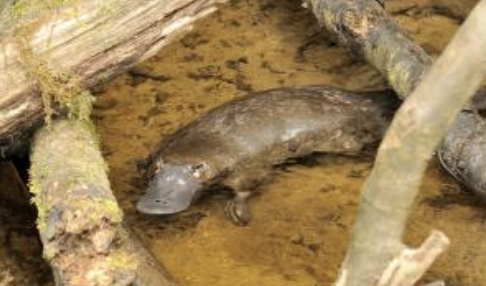
Also visited the platypus exhibit. The Safari Park is the only zoo outside Australia to have platypuses. They are nocturnal, so their exhibit is darkened during zoo hours, and it is difficult to see them clearly.
The platypus is an egg-laying mammal, one of only five such species. Again, we’re going to use a photo from the Zoo website.